Folks usually come to me with the logistical questions first — what variety to plant, what it’ll yield, how soon they’ll harvest. All fair. But the practice that quietly decides more than almost any of those rarely makes the list: pruning.
If there’s one thing a visit to a chestnut orchard in Chile drove home for Brett Hundley of Agroforestry Partners, it’s this — chestnut tree pruning isn’t optional, and it isn’t something you catch up on later.
On a recent episode of Branching Out: Growing Together, Brett described what he observed on one of the first farms he visited during a research trip to Chile — a country where chestnut production is well-established and growers have decades of hard-won experience. One farm, about 100 acres, had fallen behind on pruning. The trees had grown into each other. The canopy was dense and crowded. And when harvest came? The production on that farm was noticeably lower than on the better-managed properties they visited. The farmer knew it. He was open about it. And it was one of the most important lessons Brett brought home.
He’s not alone in that observation. It echoes what experienced growers across the U.S. have been saying for years on this podcast. The message is consistent: prune early, prune consistently, and don’t let the work slide.
Why Pruning Matters So Much in a Chestnut Orchard
Chestnut trees are vigorous growers. Left to their own devices, they’ll push for height and spread in ways that might look impressive but actually work against your production goals. Chestnut tree pruning redirects that energy.
When you prune correctly, you’re doing several things at once. First, you’re establishing a strong central leader or open vase structure, depending on your management goals and equipment access. Second, you’re improving light penetration into the canopy — and light is directly tied to nut development. Third, you’re creating airflow, which reduces the humidity that invites fungal pressure. And fourth, you’re making harvest easier, since lower, more accessible canopies are much faster to work with at scale.
Amy Miller, Chief Operating Officer of Route 9 Cooperative in Ohio, describes the annual management cycle clearly: in August and September, just before harvest season, the orchard floor needs to look like “a nice golf course lawn” so that fallen nuts can be efficiently collected. That level of floor management is only achievable when the canopy above it has been properly shaped. Pruned trees also tend to produce larger, more uniform nuts — and consistently sized nuts matter when you’re grading for size-based markets or building a reputation for quality with buyers.
The Window That Closes Faster Than You Think
Here’s the part that catches new growers off guard: the right time to establish your pruning program is in the first two to three years after planting. Those early years, when the tree is still young and pliable, are when you can most easily shape structure. Once a chestnut tree is five or six years old and has grown into itself — especially if it’s been crowded by neighbors — corrective pruning becomes much harder, slower, and more disruptive to the tree.
This is exactly what Brett observed in Chile. The farm that hadn’t kept up wasn’t dealing with a single bad season. It was dealing with the compounded consequences of several years of deferred work. Correcting that kind of structural problem takes multiple seasons and significant labor — and all the while you’re losing production you won’t get back.
The lesson is simple but easy to overlook: start your pruning program in year one and don’t stop.
Spacing, Thinning, and the Long View
Chestnut tree pruning doesn’t happen in isolation — it connects directly to how you’ve spaced your orchard and what your long-term thinning plan looks like.
Tom Wahl of Red Fern Farm in Iowa, who has been growing chestnuts since 1990, has thought about this longer than almost anyone in the U.S. industry. He recommends starting at 20 by 20 foot spacing, with a planned thinning sequence as the trees mature: first to 40 by 40, then 80 by 80, then eventually to 160 by 160 — at which point, he notes, well-managed trees can be expected to produce for another 500 to 1,000 years. In Europe, that’s not a fantasy. It’s the documented history of old-growth chestnut orchards.
His key principle: “Once the crowns of the tree start to touch — or just before they start to touch — you start thinning.” The timing is everything. Waiting until trees are fully overcrowded means you’ve already lost production. Tom also shared a striking data point from a speaker at a chestnut growers conference: Chinese growers using a tight spacing of roughly three by seven feet were achieving 9,000 pounds per acre — more than twice the highest yields reported in North America. The lesson isn’t to copy that spacing, but to take seriously how much canopy management affects yield.
Bob Stehli of Wintergreen Tree Farm in Ohio, who has planted over 30,000 trees across 180 acres, recommends starting at 15 by 20 or 20 by 20 foot spacing, with the understanding that thinning will begin around years eight to ten. His advice: keep production records on individual trees from the start, so that when thinning time comes, you’re removing the underperformers and keeping your best producers. So every thinning decision becomes a genetic selection decision — which is how you improve your orchard over time.
What Good Chestnut Tree Pruning Looks Like
You don’t need to be an arborist to prune chestnut trees well, but you do need a clear objective and consistent follow-through. Here are the core principles:
- Establish your structure early: In the first two years, focus on selecting and protecting a dominant central leader or your intended scaffold branches. Remove competing leaders that would create weak, crowded crotches. This early investment pays dividends for the life of the tree.
- Keep the canopy open: As the tree matures, remove crossing branches, inward-growing wood, and water sprouts. The goal is a canopy where sunlight reaches the interior. If you can stand inside the drip line and look up and see sky through the branches, you’re in good shape.
- Prune when the tree is dormant: Late winter — after hard freezes have passed but before the tree breaks dormancy — is generally the best window for major structural pruning. Minor touch-ups and sucker removal can happen throughout the season.
- Match your spacing to your equipment: If you’re planning to harvest mechanically, your pruning strategy needs to account for canopy height and row clearance from day one. Trees pruned for hand harvest look different from trees pruned for machinery access. Decide early.
- Don’t be afraid of the chainsaw: Ohio grower Greg Miller is known for keeping a chainsaw as one of his primary orchard management tools. When a tree isn’t performing, you either graft to it or remove it. Sentimentality about underperforming trees costs you space, light, and yield.
The Connection to Harvest
One of the other major learnings from Brett’s Chile trip was about harvest machinery — and pruning connects directly to that. The farms that had well-managed, open canopies with clear alleyways moved harvest equipment efficiently. The farms that were crowded and overgrown were slow, difficult, and prone to leaving nuts on the ground.
In his trip notes, Brett shared the following operational details: Farm 1 — 200 acres, 15 years old, well-managed — completed harvest in five weeks with only 5–10% shrink left in the fields. Farm 2 used what’s considered the “Ferrari” of chestnut harvest equipment, the Monchiero — but that machine moves slowly when leaves and other debris are present on the orchard floor. An unmanaged canopy drops more debris. More debris means slower harvest passes, more equipment passes, and more time pressure in an already tight window. The equipment can’t compensate for what the pruning work left undone.
There’s another post-harvest consequence of poor canopy and orchard management worth knowing: bur disposal. Chestnuts produce a roughly 1:1 ratio of burs to nuts — for every pound of nuts, you’re dealing with about a pound of burs. Burs left in the field invite fungal proliferation. So orchard floor discipline — which begins with a well-shaped canopy that allows proper mowing and visibility — affects not just your harvest efficiency but your orchard health going into the next season.
For a 1,600-acre operation facing a four-to-six-week harvest window — potentially shortened further by rain — the difference between a well-pruned and a poorly-pruned orchard isn’t cosmetic. It’s the difference between getting the crop in and leaving money on the ground. Even at small scale, the same principle applies: a well-pruned orchard is a pleasure to harvest. A crowded one is a chore.
Pruning Days at EBB Farms
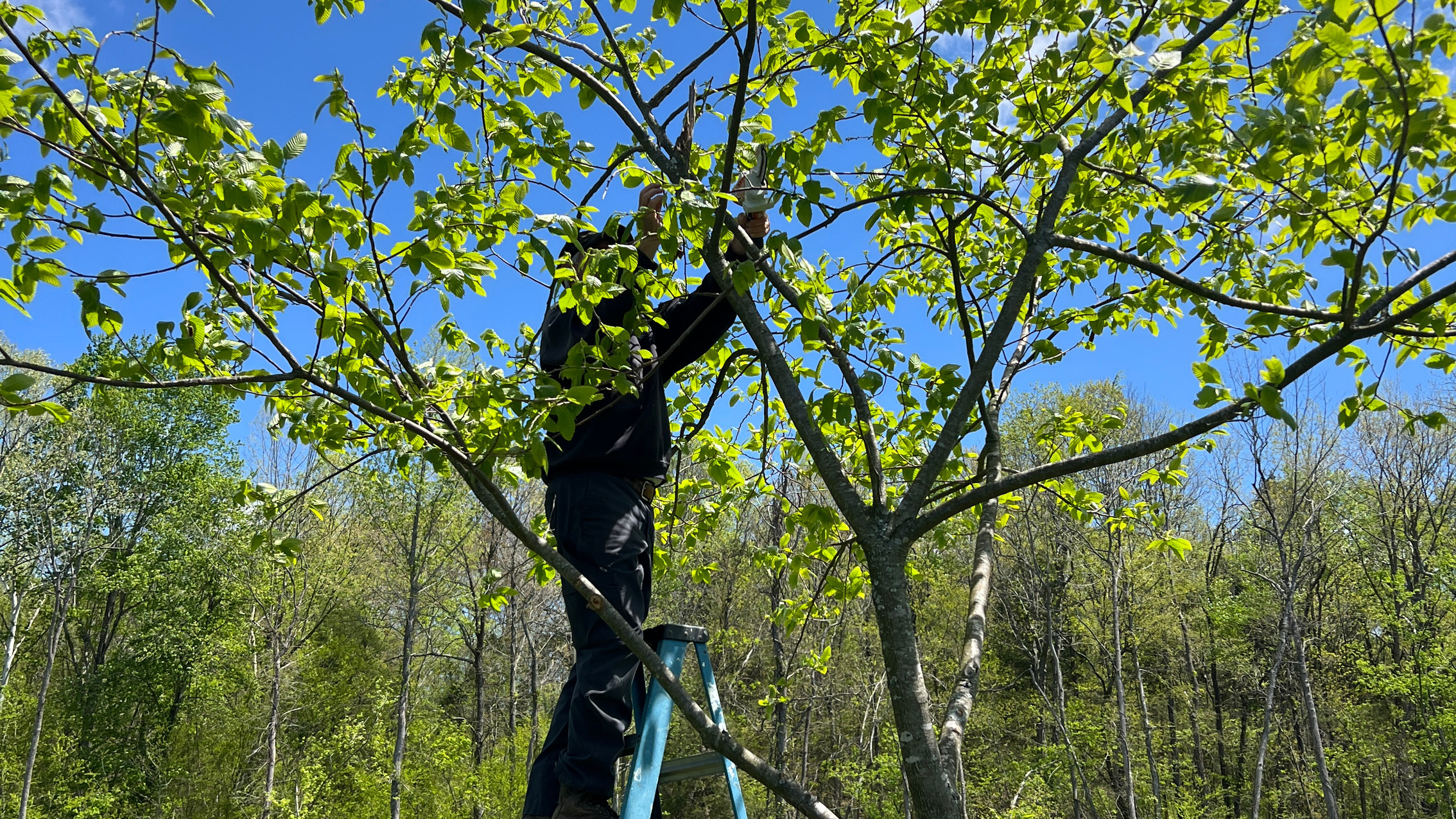
At EBB Farms — our farm lab — pruning days are pretty simple. Brad grabs a ladder, Melanie grabs a pair of loppers, and the work happens tree by tree, fixing what the weather and time have done.
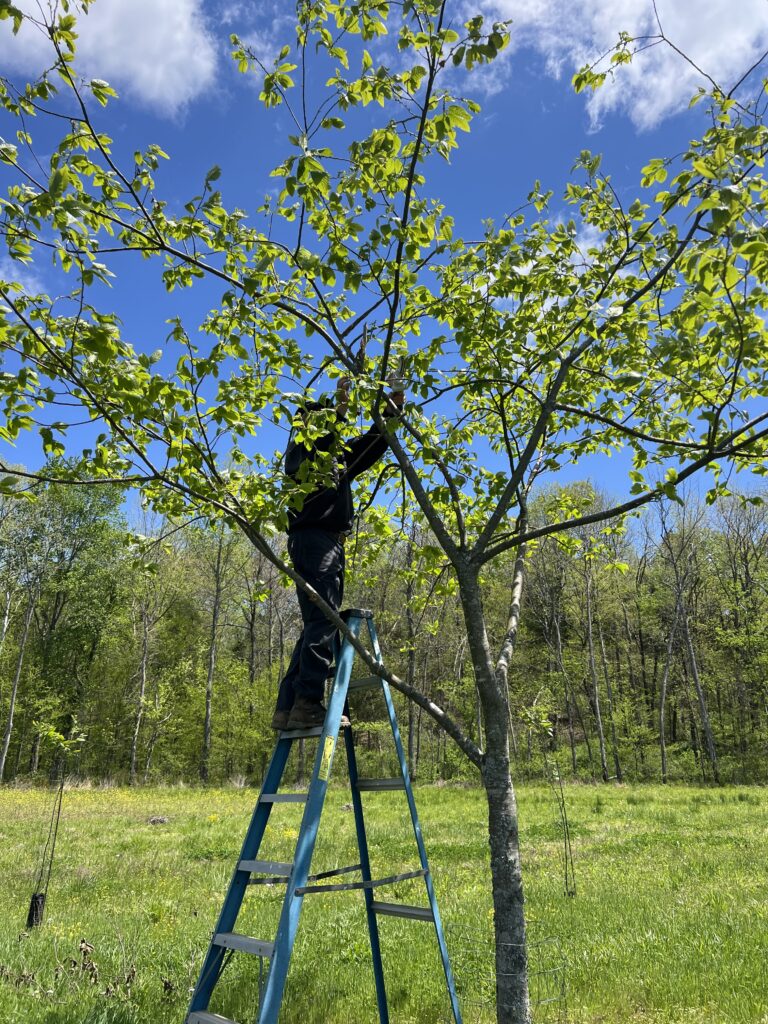
Brad takes out a damaged limb on a young tree before it turns into a long-term problem.
The lesson is simple: if those problems are ignored, the orchard ends up fighting the same bad structure for years.
A small cut now. Or the same fight, season after season.
Most of the bigger structural cuts happen in late winter, when the trees are dormant and heal quickly — but orchard life doesn’t always wait for the perfect calendar window. When a branch splits in a storm or starts shading out the center of the tree in late spring, it makes more sense to step in and fix it than to put it off and let the problem grow. At EBB Farms, pruning is part of showing up for the orchard — keeping the canopy open, the trees safer to work under, and the future nut crop moving in the right direction.
That mindset is exactly what Brett saw in Chile — the farm from the start of this article, the one that fell behind on pruning and paid for it at harvest. The takeaway there is the takeaway here: start shaping early, stay consistent, and don’t let pruning slide, because the cost eventually shows up in lower production and a harder harvest.
If you’d like to go deeper on what Brett saw in Chile, including photos and detailed yield notes from those orchards, email us at [email protected] and we’ll send you his slide deck.
Start Now, Not Later
Chestnut tree pruning is one of those practices where the return on investment is almost entirely invisible for the first few years — and then suddenly, unmistakably visible when your neighbor’s crowded trees are underperforming and yours aren’t.
The farmer in Chile who didn’t prune enough wasn’t careless. He was probably just busy, like most of us. But his trees, and his harvest numbers, told the story clearly. You don’t have to repeat it.
Start your pruning program this season. Your trees — and your future harvest — will thank you.
Thanks for being part of this. And as always — keep branching out.
Resources for Getting Started
- The University of Missouri Center for Agroforestry has published practical guides on chestnut orchard management, including pruning recommendations: centerforagroforestry.org
- Connecting with other growers through Chestnut Growers of America is one of the fastest ways to learn from people who’ve already made the mistakes so you don’t have to.
- Farm tours — including at our own EBB Farms — and other established operations are invaluable; seeing a well-managed orchard in person teaches things no article can fully convey.