November 23, 2026
Chestnut Crop Insurance: What a 100% Freeze Taught a West Virginia Orchard Grower
Most years, a late frost takes part of an orchard. The low ground goes and the high ground makes it, or the other way around, and the farm carries on with what’s left.
This spring was not most years. In April, a hard freeze hit fruit growers across Virginia and West Virginia after a warm March had pushed trees into early bloom. Ellis Shanholtz’s family lost everything. Every apple and every peach on their orchard in Romney, West Virginia, froze. The only reason the farm came through the year in decent shape is that it was insured, and well.
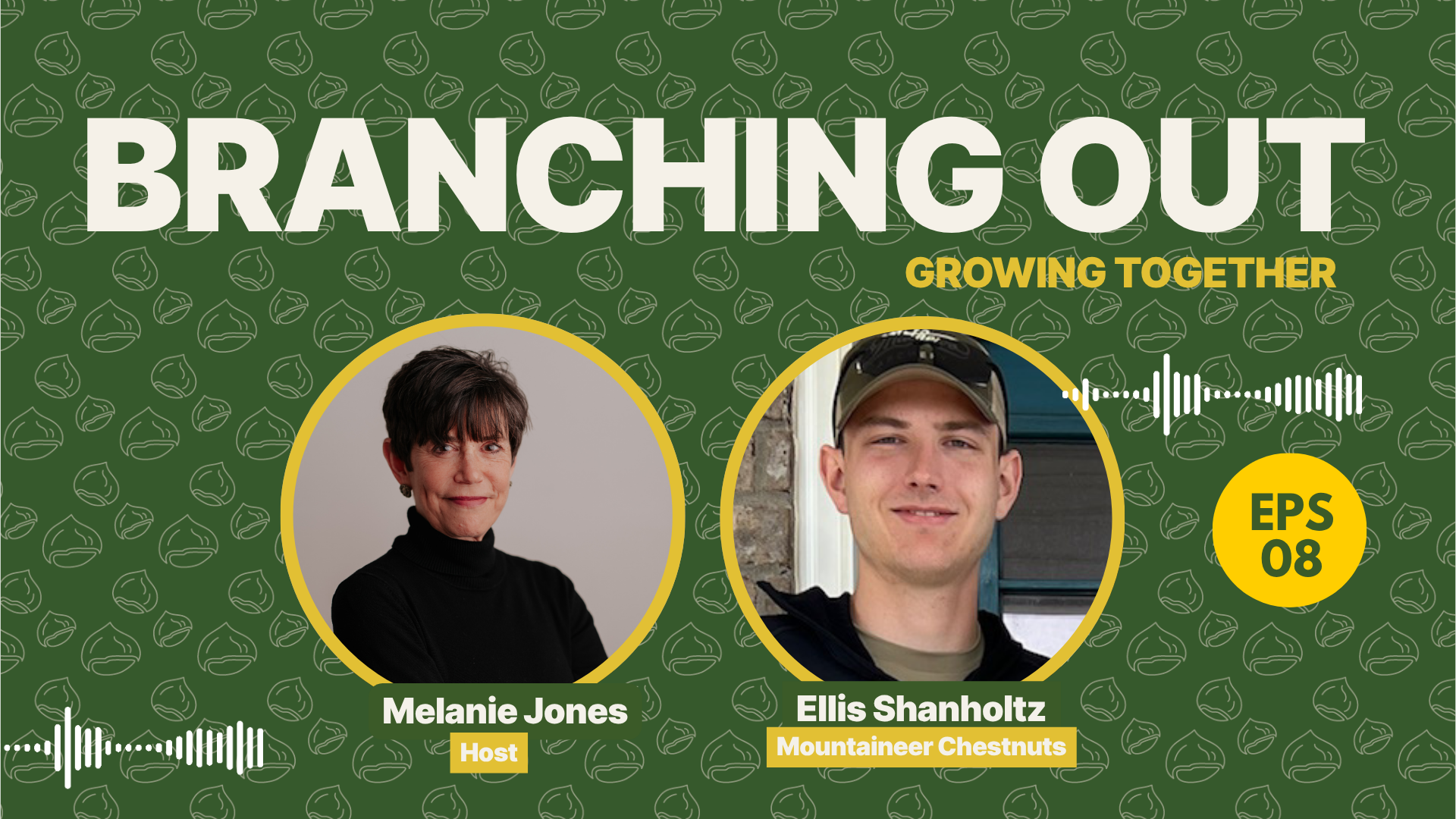
Ellis is the fourth generation on Shanholtz Orchards, and he’s now planting chestnuts on the same land. So when he sat down with our host Melanie Jones on Branching Out: Growing Together, he had one question on his mind that a lot of chestnut growers share: what protects a chestnut orchard in a year like this one?
Listen on: Apple Podcasts · Spotify · iHeartRadio · Audible
What’s in the episode
| Time | Ellis on… |
|---|---|
| 2:50 | Shanholtz Orchards, started by his great-grandfather in the 1950s |
| 4:03 | Why his county went from fruit country to “now there’s nobody” |
| 5:17 | Flying for a living, and why chestnuts fit a pilot’s schedule |
| 7:38 | Why he says there’s no chestnut industry without crop insurance |
| 8:31 | The 100% freeze, and what insurance did for the farm |
| 11:26 | Grants, the deer fence, and the Expanding Agroforestry Project |
| 13:37 | A year of “analysis paralysis,” and the farm tour that ended it |
| 18:58 | How much labor 3 acres of chestnuts actually took |
| 25:24 | Winning over a skeptical family |
| 30:48 | “Corn growing on a branch”: his pitch to row-crop farmers |
How Does Crop Insurance Work for an Orchard in a Total-Loss Year?
On Shanholtz Orchards, it worked the way it’s supposed to: the policy paid on the share of the crop that was lost, and the extra coverage the family had bought kept the farm close to even in a year with no fruit.
Shanholtz Orchards sits on about 300 acres in Hampshire County, with apples, peaches, plums and cherries. The family bought the land in 1957, and it’s one of the last orchards still running in a part of West Virginia where, a few generations ago, you couldn’t look in any direction without seeing an apple tree.
Crop insurance has been part of how the family protects that legacy for years, as Farm Credit of the Virginias reported in a 2022 profile of the orchard. Their policy pays out on the share of the crop that’s lost, so a 50% loss brings a 50% payment. They had also paid for buy-up coverage, a higher level of protection than the basic policy, and this was the year that choice mattered. Once labor costs were figured in, Ellis said, the farm came out about even, close to where it would have been with a full crop.
Without insurance, he told us, they wouldn’t have stayed afloat.
He’s seen what happens to the farms that don’t. Over the past 20 years in his valley, orchards that couldn’t absorb a bad year have been pulled out and planted to corn and soybeans. Labor costs and overhead push growers that way too, he says, but going without coverage has hurt plenty of them. And he doesn’t expect the weather to make it easier. “Every year is a weird year with the weather,” he said. “And it seems like it’s only getting weirder.”
Is There Crop Insurance for Chestnuts?
Not yet. Apples and peaches have crop insurance policies written for them, but there is no federal crop insurance policy built around how a chestnut orchard grows, how long it takes to bear, or how its nuts are sold.
Ellis thinks that has to change before chestnuts can become a real industry. “I don’t think there will be a chestnut industry without crop insurance specifically for chestnuts,” he said. He doesn’t want chestnuts lumped in with every other specialty crop. He wants coverage designed for them.
He’s not alone in pushing for it. Melanie mentioned in the episode that Agroforestry Partners, which has planted close to 2,000 acres of chestnuts in Kentucky and Ohio, is working on chestnut coverage, though it isn’t available yet. Ellis expects the gap to close as more orchards start producing. With that many acres coming into production, he said, somebody is going to want to insure them.
What Federal Programs Can Chestnut Growers Use Now?
Until a chestnut policy exists, three federal programs can help: the Noninsured Disaster Assistance Program (NAP), Whole-Farm Revenue Protection (WFRP) and the Assistance for Specialty Crop Farmers (ASCF) program. All three start the same way: a USDA farm number and an acreage report filed with your county Farm Service Agency office. If you haven’t done that yet for your chestnuts, do it first.
What Is NAP, and Does It Cover Chestnuts?
NAP can cover chestnuts in counties where FSA lists them as an eligible crop. It’s run by the USDA Farm Service Agency for crops that don’t have their own insurance policy. When a natural disaster cuts your yield, destroys the crop or keeps you from planting, NAP pays part of the loss. Basic coverage pays on 50% of your approved yield at 55% of the average market price. Buy-up coverage goes higher, up to 65% of yield at up to 100% of the price, for an added premium. There’s a service fee of $325 per crop per county, capped at $825 per county or $1,950 if you farm in more than one county. Whether chestnuts qualify where you farm, and when the application deadline falls, depends on your county, so the Farm Service Agency sends growers to their local office for those answers.
Can Whole-Farm Revenue Protection Cover a Chestnut Orchard?
It can. Whole-Farm Revenue Protection comes from the USDA Risk Management Agency, and instead of insuring one crop, it insures the revenue of the whole farm under a single policy. It’s available in every county and covers farms with up to $17 million in insured revenue, including farms with specialty crops and farms that sell directly to customers. The RMA also offers a smaller Micro Farm version. For a farm like Ellis’s, where chestnuts are being added alongside apples and peaches, a whole-farm policy may fit better than a single-crop program. A crop insurance agent can tell you whether it works for your mix.
What Is the Assistance for Specialty Crop Farmers Program?
It’s a newer program, not insurance. The 2026 Assistance for Specialty Crop Farmers program, run by the Farm Service Agency, lists chestnuts among its eligible crops. It pays a one-time bridge payment based on the planted acres you’ve reported to FSA, which is one more reason that acreage report matters. NCAT has a plain-language summary of the payment rates and enrollment period.
How Do New Chestnut Growers Manage Risk Before Coverage Exists?
Most manage it by not betting everything on the trees in the early years. That’s how Ellis is doing it. He isn’t waiting for chestnut insurance to plant.
His income doesn’t depend on the harvest. He flies commercially on a week-on, week-off schedule, and he agrees with what other growers have said on our podcast: if you want to start chestnut farming, you’d better have a really good day job to carry you while the trees grow.
His family’s existing coverage carries the farm while the chestnuts come into production, and he’s using public programs where he can. A government cost-share program helped the farm build a deer fence a few years ago, so the ground he’s planting next is already protected. He’s also applied to The Nature Conservancy’s Expanding Agroforestry Project to help pay for planting.
And he paid for good trees. All 300-some trees in his first planting lived through their first year. His view is that it costs less to buy a good tree once than to replace a cheap one two or three times.
What Should You Ask FSA and a Crop Insurance Agent Before Planting Chestnuts?
Ellis’s family chose its coverage level before the freeze, and that choice decided how the year ended. The same is true for anyone adding chestnuts. These are the questions that get you real answers instead of a brochure.
At your county FSA office, about NAP:
- Are chestnuts an eligible crop for NAP in this county, and is there an established price and yield for them?
- When is the application closing date for chestnuts? (If you miss it, you can’t apply for that crop year.)
- If my trees aren’t bearing yet, what does NAP cover, if anything?
- What records will I need to prove a loss: planting dates, tree counts, sales receipts?
With a crop insurance agent, about Whole-Farm Revenue Protection:
- Would Whole-Farm Revenue Protection or Micro Farm fit my mix of crops, including chestnuts and anything I sell direct?
- How many years of farm tax records do I need to qualify?
- What would buy-up coverage cost on the crops I already grow, so they can carry the farm while the trees come in?
Write the answers down with the date and the name of the person you spoke with. Programs and deadlines change, and next year you’ll want to know what you were told.
How Do You Plan a Chestnut Orchard for a Year With No Crop?
Insurance only covers part of the risk. The rest is how your farm is set up before a bad year comes. Ellis’s setup gives you a checklist to hold your own plan against:
- Income: If the chestnuts produced nothing for three years, what pays the bills? For Ellis, it’s his flying.
- Coverage you already have: Which of your existing crops are insured, and at what level? Those policies are what carry the farm while the trees grow.
- Cost-share: What will deer, fencing or planting cost on your ground, and which programs could share it? Ellis’s deer fence came through a government cost-share program before he planted.
- Trees: Are you budgeting to buy good trees once, or cheap ones two or three times?
If you can’t answer one of these yet, that’s the part of your plan to work on before planting season.
Where to Go Next
If you’re weighing these decisions now, you don’t have to do it alone.
- See a working orchard. A Chestnut Farm Tour and Chestnut Farm Blueprint lets you walk the EBB Farms orchard and nursery and ask your questions, the way Ellis did.
- Set up the business side. The Starting Your Chestnut Farm Business Guide covers your USDA farm number, acreage reporting, NAP and liability insurance.
- Plan the orchard. UC Academy guides walk through planning a chestnut orchard step by step.
Sources
- Farm Credit of the Virginias, Crop Insurance: Protecting the Shanholtz Legacy (Sept. 14, 2022)
- USDA Farm Service Agency, Assistance for Specialty Crop Farmers (ASCF) Program (accessed Nov. 23, 2026)
- NCAT, USDA Announces Payment Rates and Enrollment Period for Specialty Crop Farmers (June 1, 2026)
- USDA Farm Service Agency, Noninsured Crop Disaster Assistance Program (NAP) (accessed Nov. 10, 2026)
- USDA Risk Management Agency, Whole-Farm Revenue Protection (accessed Nov. 10, 2026)
- The Nature Conservancy, Expanding Agroforestry Project (accessed Nov. 23, 2026)
- Propagate, Chestnuts & Agroforestry: Massive Opportunity for American Farmers (2023)
- Virginia Tech Tree Fruit Horticulture, Devastating Freeze Damage in Winchester and Parts of Virginia (April 9, 2026)
- AgWeb, A Tale of Two Harvests: How a Deadly Spring Freeze Divided Northeast Fruit Growers (2026)