May 12, 2026
Grafted, Seedling, or Clonal? A Quieter Way to Choose Your Chestnut Trees
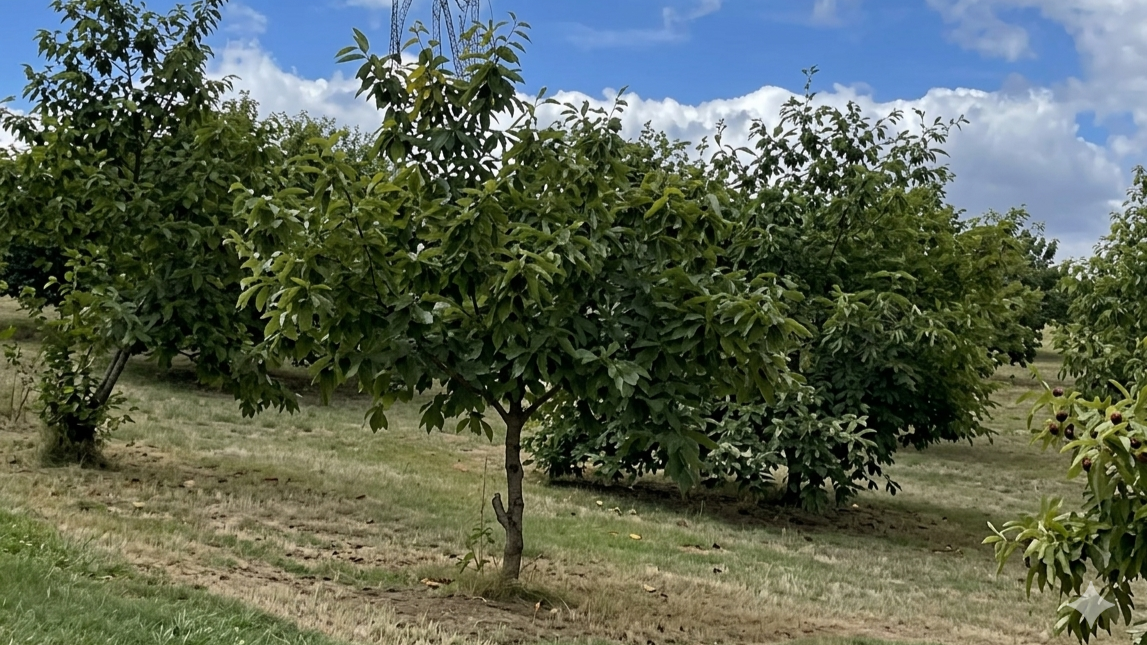
If you’re standing in front of nursery catalogs trying to decide what to plant, you’re not alone. The grafted vs seedling chestnut trees question is the one we hear most often—from first-year growers, folks fifty trees in, and researchers.
Underneath, though, is usually a quieter question. Not just “which tree?” but “what kind of orchard—and what kind of grower—are you trying to become?”
That’s the question we want to sit with today.
Three words worth slowing down on
Let’s get the vocabulary on the same page. A grafted chestnut tree is usually a named cultivar—say ‘Qing’ or ‘Peach’—fused onto a separate rootstock. You get a clone of the scion, with its nut size, flavor, and maturity pattern copied tree to tree.
A seedling tree grows from a nut. It carries genes from two parents and expresses its own blend of their traits. Sometimes that’s surprisingly uniform within a good family. Sometimes it’s widely variable.
A clonal orchard goes one step further. It uses grafting, rooted cuttings, or tissue culture to scale identical genetics. Each path has trade-offs. None of them is wrong.
Grafted vs seedling chestnut trees: the honest answer right now
In some regions, like commercial Michigan orchards, extension still recommends establishing primarily with grafted cultivars. The goal is maximum uniformity, predictable harvest windows, and strong market fit, especially at larger scales. In these systems, named cultivars are propagated by grafting or budding and are considered the current standard.
On many eastern and midwestern sites, the story is shifting. Where soils are marginal, winters are harsh, or establishment stress is high, seedlings from superior parents are now outperforming grafted trees. They often lead in both yield and survival. They also drive long-term genetic improvement.
In truly ideal environments, grafted cultivars can still deliver more uniform and predictable production when grafts are successful and well managed.
The right answer depends on your site, your goals, and how much variability you’re willing to manage. There isn’t a wrong answer here. There’s a right answer for you.
Site & Self: six questions before you order a tree
When growers bring this question to us, we don’t answer it directly. Instead, we hand back six questions—three about the land, three about the grower. We call this framework Site & Self. It’s the closest thing we’ve found to an honest shortcut.
Three site questions:
How stressful is my site—in terms of drought, wind, shallow soils, or winter extremes?
How forgiving is my drainage? Do I have deep, well-aerated soils, or do I see ponding, compaction, and waterlogging?
How variable is my growing season year to year—late frosts, erratic rainfall, heat spikes?
Three grower questions:
How much harvest-window variability can I tolerate? Am I okay with a sliding ripening window, or do I need tight, predictable drops?
How uniform do my customers need the nuts—by size, appearance, and flavor?
How long do I plan to steward this orchard—ten years, fifty, or generational?
Sit with those for a few minutes. In our experience, the grafted vs seedling chestnut trees question usually starts to answer itself.
When the land is hard
Tom and Kathy Wahl of Red Fern Farm in Iowa have been growing chestnuts for over thirty years on a site that pulls no punches. They’ve seen what happens when graft unions meet a tough Midwest profile of heavier soils, winter swings, and periodic drought.
At his place, Tom describes seedlings outperforming grafted trees by roughly five to six times in total production over time. This comes from long-term on-farm observations and trial blocks at Red Fern Farm. The exact percentage isn’t the point.
Tom’s point is simpler: on a stressful site, resilience beats uniformity. Every time.
So if your land asks a lot of your trees, his answer is clear. Plant seedlings from parents you trust and let the survivors teach you which genetics belong on your ground.
The long game with seedling chestnut trees
Greg and Amy Miller of Route 9 Cooperative and Empire Chestnut Company in Ohio decided to test this question in their own rows. In 2014, they planted alternating rows of grafted ‘Peach’ and ‘Qing’ next to their full-sib seedling offspring. Each group received the same site, management, and weather.
In one of those trials, early data showed seedlings outperforming their grafted parents in both yield and nut quality. By the 2022 harvest, that block averaged 22.4 lb/tree for seedlings. ‘Qing’ grafts averaged 17.9 lb, and ‘Peach’ grafts averaged 6.0 lb in that same planting and season.
As plant breeders, they care less about a single harvest snapshot. They focus on what those seedlings unlock over decades. They see seedling orchards as the engine of long-term genetic improvement—a primary way the chestnut industry keeps getting better.
That’s a reframe worth holding: every seedling you plant is a vote for the next chestnut grower.
When conditions are ideal
Dr. Ron Revord at the University of Missouri Center for Agroforestry takes a both-and position—not as a hedge, but as a discipline. He helps lead the Chestnut Improvement Network, where coordinated on-farm trials are mapping which genetics belong where across real orchards.
In environments that are truly ideal—deep, well-drained soils, moderate winters, good air drainage, and strong management—his team does recommend grafted trees. In those conditions, orchard-level production and uniformity are typically higher when grafts perform well.
At the same time, CIN and related work are candid about the risks. On more stressful or marginal sites, graft unions fail more often. Grafted Chinese chestnuts can show reduced vigor and inconsistent cropping.
His recommendation always comes with site-specific caveats. Above all, he wants growers to let the land author the planting plan—not the catalog.
The third door
Meanwhile, a third path is gaining ground. Craig Clark of West Coast Chestnut and other nursery leaders expect chestnut to follow hazelnut’s arc toward more tissue-culture-driven clonal systems. This is especially true in regions already relying on grafted European and hybrid material.
Growers like Abby Johnson and the Nash family in Michigan are already blending systems. They use grafted trees, rooted cuttings, and limited tissue-culture clones. At the same time, they keep seedlings in the mix for adaptation and breeding.
None of this suggests tissue culture will replace seedling families. Most researchers expect a mixed landscape. Clonal lines will serve specific niches, while seedling systems continue to drive adaptation and improvement.
In practice, these growers treat clonal propagation as one more door—not the only one.
Bringing it home
So which way should you plant?
It depends on what your land asks for and what you’re trying to grow into as a producer.
We don’t always know our full answer at the start. That’s okay. Plant a row. Watch what survives and thrives. Let the trees keep teaching you.
The clearer you get on Site & Self, the less the catalogs will pull you in directions that aren’t yours. This isn’t just a planting decision. It’s a slow unfolding of the kind of grower you’re becoming—and the genetics you’re stewarding forward.
If you want company in that unfolding, this month’s pillar episode with Jon and Bill Nash is a good place to start. The full Tom Wahl, Dr. Greg Miller, and Dr. Ron Revord conversations live in the Branching Out: Growing Together archive.
As always—keep branching out.
Key Takeaways
- The decision between grafted vs seedling chestnut trees depends on your site, goals, and tolerance for variability.
- Grafted trees offer uniformity and predictability in favorable conditions, while seedlings excel in stressful environments, outperforming grafted trees in many cases.
- Evaluate your land and personal preferences using the Site & Self framework of six key questions before deciding on tree types.
- A mixed approach, blending grafted trees, seedlings, and clonal systems, is emerging as a viable option for growers.
- Planting is not just a choice but a journey that defines your growth as a producer and shapes the genetics of your orchard.