
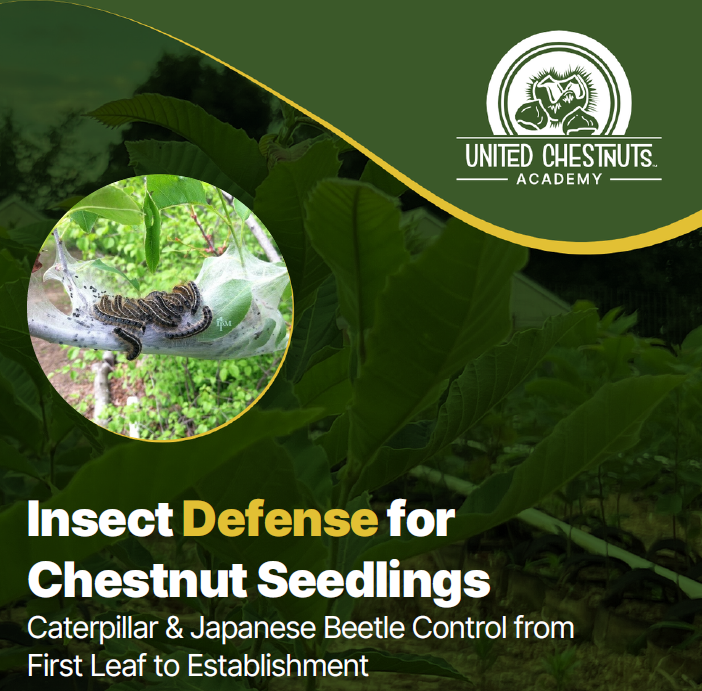
Insect Defense For Chestnut Seedlings
$15.00
A UC Academy field guide from EBB Farms covering caterpillar and Japanese beetle identification, permethrin mixing rates, spray timing, and a pre-application safety checklist for young chestnut seedlings.
What is this guide?
Insect Defense for Chestnut Seedlings is a United Chestnuts Academy field guide built from the spray protocol EBB Farms actually uses on its own seedlings every spring. It walks you through why the first spring after planting is the highest-risk window for insect damage, how to identify the five pests that do the most harm to young trees, and exactly how we suggest mixes, times, and applies treatment — whether your seedlings are growing in tree tubes or open wire cages. This is not generic pest-control advice; it is the calendar and checklist EBB Farms follows on its own rows in Kentucky.
Why growers use this guide
-
Identify eastern tent caterpillar, forest tent caterpillar, cankerworms, fall webworm, and Japanese beetle before damage sets in, with photos and a quick-reference timing table.
-
Understand why a seedling with eight leaves can’t absorb the same defoliation a mature tree shrugs off — and why the spray window is measured in days, not weeks.
-
Get mixing-rate starting points for hand-pump and backpack sprayers, plus the application-timing rules that protect pollinators and avoid wasted sprays before rain.
-
Follow separate, illustrated spray techniques for tree-tube seedlings versus open wire-cage seedlings, since each setup demands a different approach to get insecticide where the insects are actually feeding.
-
Run through a pre-application safety checklist covering PPE, wind, weather, water proximity, and pollinator timing before every treatment.
What’s inside
-
Part 1 — Why This Window Matters: the biology behind why seedling-stage defoliation stalls growth and invites secondary problems like borers and fungal pressure.
-
Part 2 — Know Your Enemies: identification, host preferences, and behavior for pests that attract chestnut trees.
-
Part 3 — The Chemical: how EBB Farms uses chemicals, what it controls, how it works, mixing-rate starting points, application timing, and safety and storage guidance.
-
Part 4 — Two Protection Scenarios: step-by-step spray technique for seedlings in tree tubes and seedlings in open wire cages, including coverage tips for each.
-
Part 5 — Scouting & Field Protocol: what to look for in the canopy.
-
Part 6 — Before You Spray: Field Checklist: an eight-point checklist to run through before every application.
How this guide was built
EBB Farms is the farm lab for United Chestnuts, the learning and development hub for the chestnut community, and UC Academy guides like this one come directly out of that field work. This one reflects treatment for pests found at EBB Farms and utilization for seedlings in the Midwest/Kentucky region — your local pest pressure, bud break timing, and product label may differ, so we point you to your local Cooperative Extension office and your own scouting to fine-tune the calendar. You’ll also find deeper field notes and grower resources at unitedchestnuts.com/ebb-farms, and you can hear more real-world grower stories and strategies on the Branching Out: Growing Together podcast.
Best-fit for
-
First- and second-year chestnut seedling growers heading into their first spring in the ground
-
Growers who scout their own rows and want a decision rule instead of a fixed spray calendar
-
Anyone running seedlings in tree tubes or open wire cages who needs setup-specific spray technique
-
Orchard managers building out a UC Academy reference library alongside other EBB Farms guides
Key details
-
Type: UC Academy digital field guide (PDF)
-
Length: 23 pages
-
Source: EBB Farms Lab, Falls of Rough, Kentucky
-
Covers: Pest identification, timing, permethrin mixing and application, tube vs. cage spray technique, scouting protocol, pre-application safety checklist
-
Format: Instant digital download, read on any device
-
Best paired with: Chestnut seedling purchases and tree tube or wire cage protection supplies
This is a digital product. After checkout, you’ll receive an instant download link for the PDF guide — there is nothing physical to ship. The guide is yours to keep and reference every spring.
Important note on pesticide use
This guide reflects EBB Farms’ own field practice in the Midwest/Kentucky region. Formulations, active ingredient concentrations, and registered uses vary by product and region. Always read and follow your specific product’s label in full before mixing or applying — the label is the law, and this guide does not replace it.