October 22, 2026
Colossal Orchards: 30 Years on a Washington Chestnut Farm
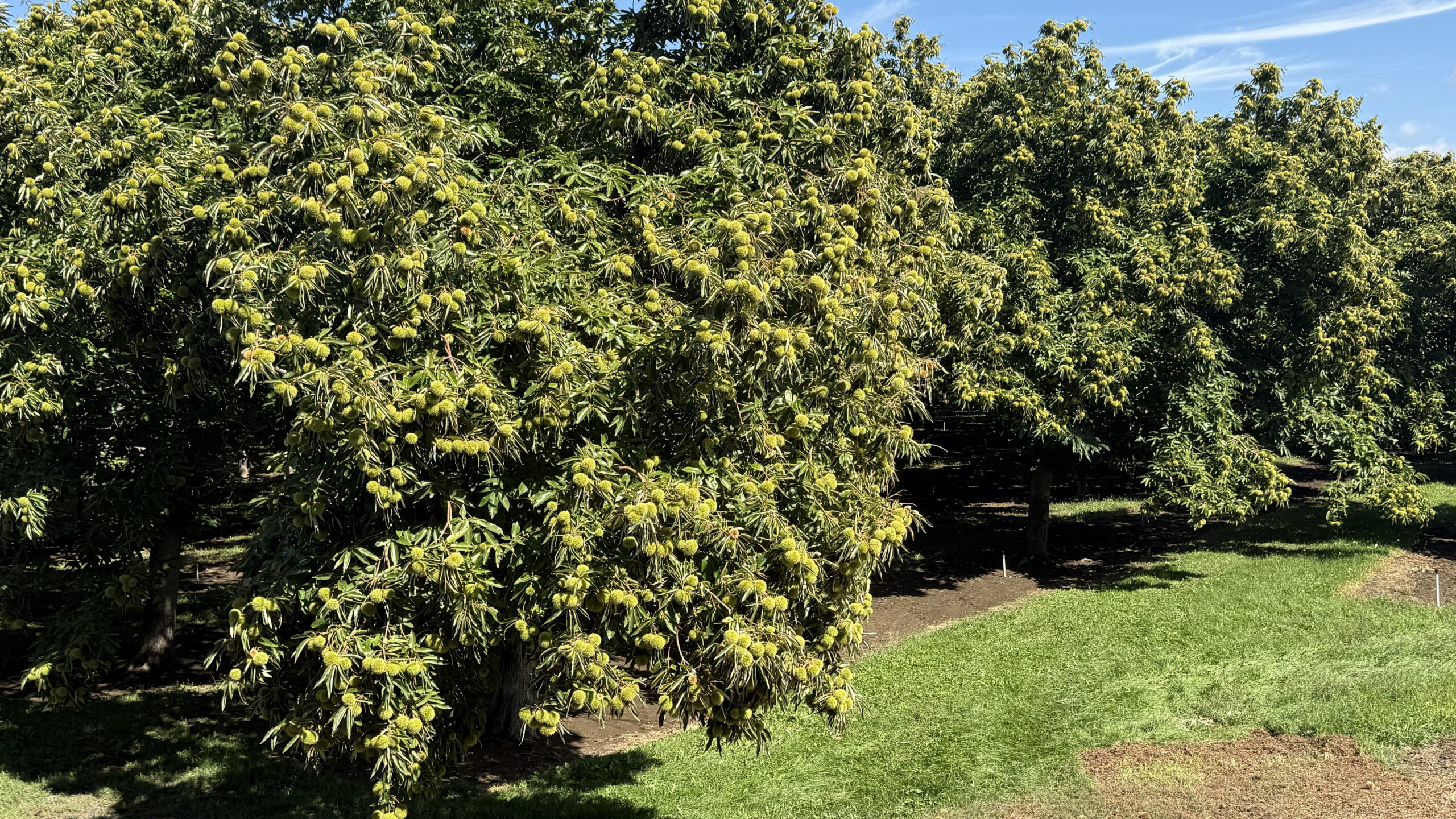
Steve Jones planted his first Colossal chestnut trees in 1992 because the gophers made a business decision for him.
The plan was a partnership: Steve in Washington, a friend in California, two orchards, one chestnut business. “Well, the gophers ate all his chestnut trees,” Steve told us, “so Patty and I are in the chestnut business all by ourselves here in Washington State.”
Thirty-some years later, Steve and Patty’s Colossal Orchards in Selah, Washington, has about 25 acres of chestnuts, a cold storage building, two people who do all the harvesting, and customers who know Patty by her first name. Roughly half of every crop goes out the back door of the farm. It’s one of just 65 chestnut farms in the US with 25 acres or more, out of 2,843.
Our host Melanie Jones asked Steve for “the beginning, the messy middle, and where you are now.” He gave her all three, plus a few opinions the chestnut industry needs to hear. Press play below, or read on for the highlights.
Listen on: Apple Podcasts · Spotify · iHeartRadio · Audible
What’s in the episode
| Time | Steve on… |
|---|---|
| 1:12 | The gophers, the partnership that wasn’t, and planting in 1992 |
| 2:34 | Why the “apple capital of the world” was a good place to learn |
| 4:15 | A PhD in cow nutrition, 50,000 dairy cows, and agroforestry, Western-style |
| 7:05 | What new growers need to understand before their trees produce |
| 9:43 | Eight inches of rain, water rights and “whiskey’s for drinking” |
| 14:18 | Labor costs, and the used equipment two people harvest with |
| 16:54 | Why big grocery chains didn’t buy enough, and what one newspaper article did instead |
| 19:25 | Why there’s no U-pick, and the first weekend the doors open |
| 29:35 | The next 10 years: “You can’t flood a market” |
| 31:08 | Patty, the phone calls, and 100 bags at a time |
| 31:55 | The year they ran short, and the buyer who was “really upset” |
Who Is Behind Colossal Orchards?
Steve and Patty Jones, who started with about 9 acres of chestnuts in 1992 and grew to about 25. “We started with about 9 acres,” Steve said. “After about 3 or 4 years, we ended up with about 16 acres… and in the last 4 or 5 years, maybe 6 years, we’ve planted another 7 and a half or so.” (1:12)
Steve had no nut-tree experience when they started. He didn’t think he needed much. “Remember, we’re in the apple capital of the world here in Washington State,” he told Melanie. “There’s a lot of aggressive growers of all kinds here. Apples, pears, sweet cherries.” (2:34) Today Colossal Orchards grows all three of its own crops: sweet cherries, canning Bartlett pears and chestnuts.
The extra acres arrived on the land’s schedule, not theirs. “When the neighbor next door to you wants to sell their property, you almost have to buy them,” Steve said, “because you never get a second chance.” (3:07)
Agriculture was already Steve’s day job. He holds a PhD in ruminant nutrition and, with a business partner, works with about 50,000 dairy cows across Washington. When Melanie asked about agroforestry, he gave us an answer we didn’t expect: out West, livestock growers have long practiced it, grazing livestock through the conifer forests where buffalo, deer and elk once foraged. His take on what limiting that grazing has meant for Western wildfires is worth hearing in his own words, at 5:15.
What Is a Colossal Chestnut Tree?
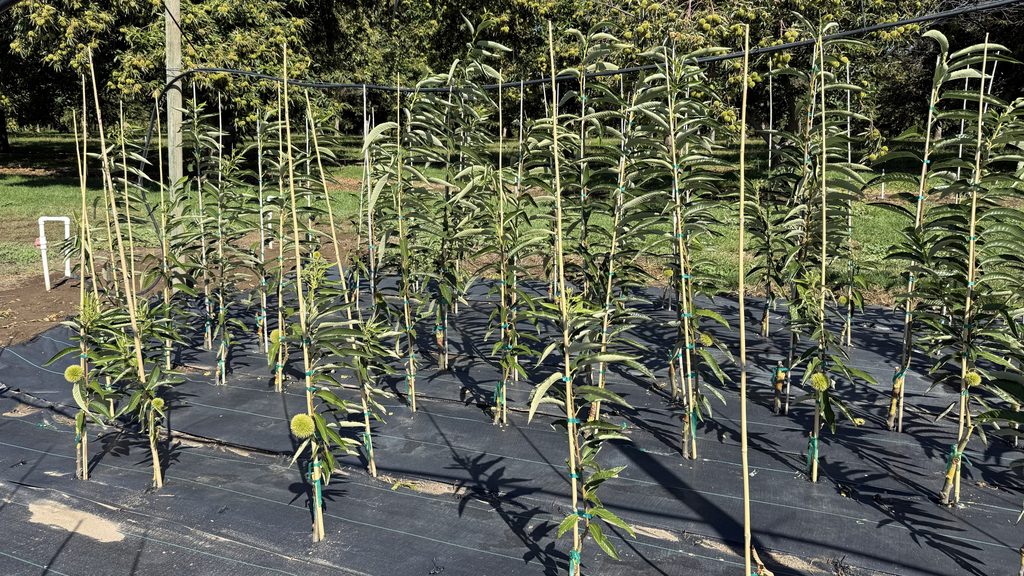
Colossal is a European × Japanese hybrid chestnut known for very large, uniform nuts, averaging about 18 per pound, and it became the industry standard in California, according to UC Agriculture and Natural Resources. It is also the variety Steve’s farm is named for.
Steve’s first trees in 1992 were grafted Colossal. A few things every grower should know about the Colossal chestnut tree before planting one:
- It needs a partner. Colossal makes little or no pollen, so UC ANR recommends one pollinizer for every 8 to 10 Colossal trees.
- The partner matters. Michigan State researchers found that Chinese chestnut pollen caused internal kernel breakdown in about 35% of Colossal trees, while Nevada and Précoce Migoule pollen caused none.
- Steve got that right early. His original planting used Silverleaf and Nevada pollinizers, years before that research was published. His newest blocks pair Colossal and Bouche de Bétizac with Maraval and Précoce Migoule.
What the variety means for selling is one of Steve’s big points, and it comes up again below. “You need to pick a variety of trees that’s marketable,” he said. “I think that’s critical.” (8:21)
When we recorded in mid-September, Colossal Orchards’ nuts were already starting to drop. “Typically, we drop, like, the last week of September, first week of October,” Steve said, and he was “hoping they hold off for another week.” Hear what an early year did to his cherries at 12:42.
How Long Does It Take Chestnut Trees to Produce?
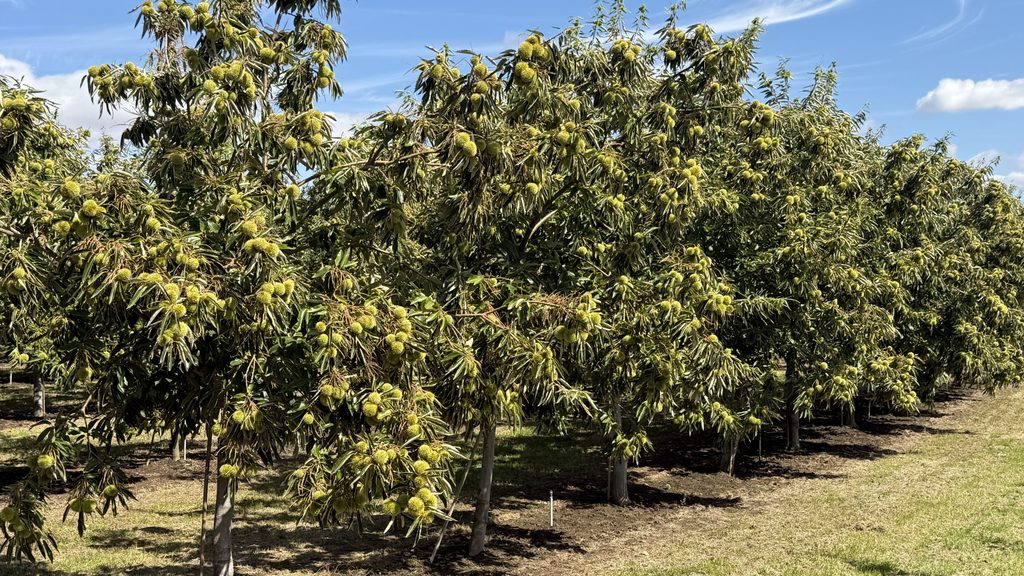
About 10 years before a chestnut orchard brings in real income, by Steve’s count. “You need to think 10 years in the future,” he said, “because that’s about the first time you’re going to get any significant income out of your chestnut crop.” (7:05)
The research agrees with him:
| Steve said | The research says | Source |
|---|---|---|
| About 10 years to significant income | Positive cash flow in years 10 to 15 | UC ANR |
| “For the first few years, you don’t produce any nuts” | First harvest around year 5, about 3,000 lb per acre at full production | University of Missouri Extension |
| “It’s a long-term investment” | Cumulative returns turn positive around year 17 (Chinese chestnut model) | University of Missouri Extension |
Steve calls those early years “a labor of love. We watered them, and pruned them, and got them to grow.” (1:40)
Melanie admitted she’d once heard that all you have to do is plant the trees and mow the grass. “We love to laugh about that here,” she said, “because it’s just every single day, there’s something.”
Steve didn’t miss a beat. “That was my next point. If you’re gonna be in the business, you really need to be pretty aggressive. You need to get your trees to grow, you need production.” (8:13)
And a decade is a long time to wait for a paycheck. Near the end of the episode, Steve put it plainly: “You have to have a good day job to be in the chestnut business.” (28:44)
What Should You Decide Before Starting a Chestnut Farm?
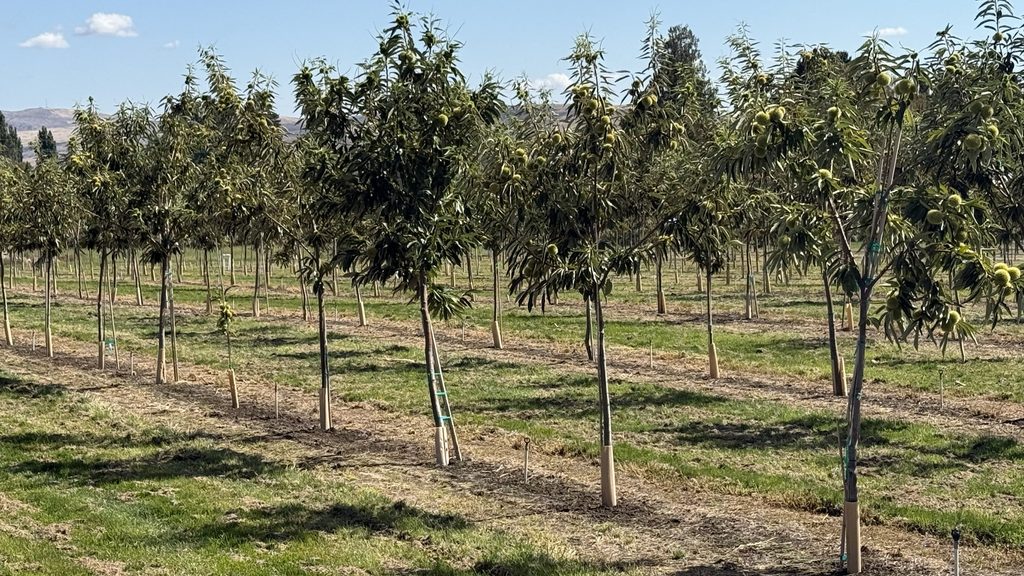
Whether you’re in it commercially or for fun. Steve put that question first: “You have to decide whether you’re going to be in this commercially, and actually sell your product, or just for fun, to sell to the neighbors.” (7:05) Both are good answers. They lead to very different farms.
After that, Steve’s list, in his own words:
- Where’s your market? “If you’re in the middle of, I don’t know, central Illinois, I’m not so sure that your market is very close to you. You need to be a little closer to Chicago, some of the bigger cities, because that’s where your market’s gonna be.” (7:28)
- A marketable variety. In the East, that tends to mean Chinese-type chestnuts; on the West Coast, European types. (8:21)
- Water. “100% of our trees are under irrigation,” in a valley that gets “a little over 8 inches of annual rainfall. We’re actually in the desert.” (9:43) Water rights in the West are serious business. As Steve put it, quoting the old saying: “Whiskey’s for drinking and water’s for fighting.” Hear why a well for your own house can need a water right in Washington at 11:00.
- Labor. Washington’s farm labor costs are close to the highest in the country, with overtime after 40 hours and a minimum wage over $17. That’s pushed Colossal Orchards to machines: “I have two guys that do all my harvesting.” (14:18) What they use, and why it’s all secondhand, is at 15:02.
Melanie added land, harvest, storage and the long-term business model. Steve said she’d covered them all: “I had to write some notes down there, because… you had everything taken care of.” (14:09)
If you get some of it wrong, you’re in good company. “You make decisions by your mistakes,” Steve said. (9:08)
How Do Chestnut Growers Find Buyers?
Slowly, at first. “It took a long time to develop a market,” Steve said, “and people finally discovered where we were, and then the market kind of develops on its own after that.” (1:54) Today close to 50% of Colossal Orchards’ chestnuts sell retail, straight out the back door of the farm.
Getting there took a detour through some of the biggest grocery chains in the country, and that detour is one of the best stories in the episode. Steve compares how grocery chains buy chestnuts to how they buy watermelons and pumpkins. Then a single newspaper article changed who was coming to the farm. Start at 16:54 to hear it.
The numbers explain why timing matters so much. Steve said grocery buyers need chestnuts through “at least a 45-60 day window during the holidays,” shipped every couple of weeks so they don’t “sit on the dock somewhere and spoil.” (17:46) US import records show the same calendar: 90% of 2025’s imported in-shell chestnuts arrived between October and December, worth $9.2 million for the year. That’s the window US chestnut growers sell into, and today imports fill most of it.
And when the farm finally opens its doors each fall? “That first weekend, the amount of chestnuts that move in one weekend is just amazing to me,” Steve said. “Still is today.” (19:43)
Much of that is Patty. Steve calls her his “head marketing agent.” Customers start calling at the end of August. “They all know her by first name, they all have her cell phone number,” he said. “They all call, and they commiserate for 10 or 15 minutes when they order 100 bags of chestnuts. So it’s fun for me. I don’t know how much she enjoys it.” (31:08)
Chestnut Farming in the USA: Where Is It Headed?
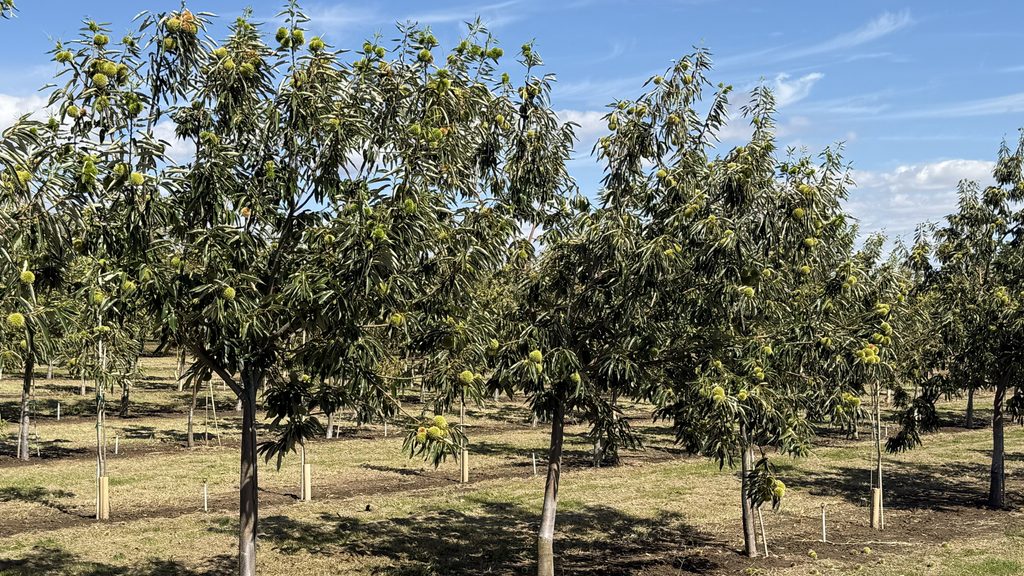
Toward more trees than buyers, unless growers plan for it. The USDA counted 2,843 chestnut farms in 2022, up 85% from 2017, and most of those young trees aren’t producing yet.
When Melanie asked what the next 10 years look like, Steve didn’t talk about growing. He talked about selling. “There’s a lot of acres that are going to be in production in the next few years, so marketing chestnuts is the biggest issue for me. You can’t flood a market, in my opinion, and expect prices to hold.” (29:35)
He’s seen it happen next door. “We grow so many sweet cherries here in the Pacific Northwest that if there’s a large crop, nobody makes any money.” (30:22)
Steve’s fixes are cooperative ones, which is notable from someone who also told us, “we’re all competitors.” He’d like Chestnut Growers of America to offer:
- Voluntary “rules for the road.” A shared set of good agricultural practices, so a buyer knows what they’re getting from any CGA grower. (22:08)
- One way to grade chestnuts. “Our smallest size is an inch and an eighth. We don’t sell anything smaller than that,” Steve said. Many Chinese chestnuts sold in the East are an inch or less. “So, how do we grade chestnuts to match everybody’s profile?” (26:10)
- A clearinghouse. A place where a produce company can find four or five qualified growers. Steve knows why it matters: in one short year, about 65,000 pounds, he didn’t have enough jumbo and extra-large nuts, and one of his biggest buyers was “really upset. I had no chestnuts for them.” (31:55)
Steve has done this kind of thing before. “Remember, CGA started on the West Coast,” he reminded Melanie. He was part of the group that formed the Western Chestnut Growers, which became the national Chestnut Growers of America in 1996. (25:04)
Colossal Orchards by the Numbers
| Figure | Source | |
|---|---|---|
| First Colossal chestnut trees planted | 1992 | Steve Jones, Ep. 32, 1:35 |
| Chestnut acreage | about 9 → 16 → 25 acres | Steve Jones, Ep. 32, 2:08 |
| Share of crop sold at the farm | close to 50% | Steve Jones, Ep. 32, 19:20 |
| Smallest nut sold | 1⅛ inches | Steve Jones, Ep. 32, 26:19 |
| A short crop year | about 65,000 lb | Steve Jones, Ep. 32, 31:59 |
| Cold storage | 3,800 sq ft | Steve Jones, Ep. 32, 15:29 |
| Normal harvest window | last week of Sept to first week of Oct | Steve Jones, Ep. 32, 13:21 |
| US chestnut farms, 2022 | 2,843 (65 with 25+ acres) | USDA NASS, Table 37 |
| US in-shell chestnut imports, 2025 | $9.2M; 5.6M lb | US Census Bureau |
| US share of world chestnut production | under 1% | West Coast Nut |
Colossal Orchards’ figures are one farm’s experience, reported by the grower. Import values are declared customs values, not wholesale or retail prices.
Hear the Whole Conversation
This article covers the highlights. The episode has the rest: the Kroger story, the newspaper article that brought customers to the farm’s door, why Colossal Orchards had to stop letting people pick their own, what it takes to sell to Whole Foods, and Steve’s thoughts on marketing orders for chestnuts. Thirty-five minutes with a grower who’s been doing this since 1992.
[EPISODE EMBED or podcast app links]
And if you’re facing these decisions now, you don’t have to do it alone. Our UC Academy guides walk through planning a chestnut orchard step by step. If you’d like a plan built around your own land, a Farm Tour with Orchard Blueprint and SEO analysis maps your orchard and your market together. Steve figured a lot of this out the hard way. We’d love to help you figure it out a little faster.
Sources
- Branching Out: Growing Together, Episode 32, Steve Jones of Colossal Orchards, hosted by Melanie Jones (recorded Sept. 14, 2026). Timestamps in this article are from the raw recording. [ADD published episode URL]
- Colossal Orchards, farm history
- USDA NASS, 2022 Census of Agriculture, Table 37: Specified Fruits and Nuts by Acres, 2022 and 2017
- Vossen, P. Chestnut Culture in California, UC ANR Publication 8010
- Fulbright, D.W. et al. “Kernel Breakdown Appears When Hybrid Castanea Cultivars Are Pollinized by Castanea mollissima,” Acta Horticulturae 1019
- University of Missouri Extension, G739: Chinese Chestnut Planning Budget (2025)
- Oberst, G. “Chestnuts: Could This Ancient Nut Be the West’s New Pioneer?” West Coast Nut, Dec. 2024
- US Census Bureau, USA Trade Online, HS 0802.41 chestnuts in shell, imports 2025 [VERIFY: confirm source and kg unit of the supplied file]