March 1, 2026
Taller Isn’t Better: Why Our Best Chestnut Seedlings Ship at Four Feet
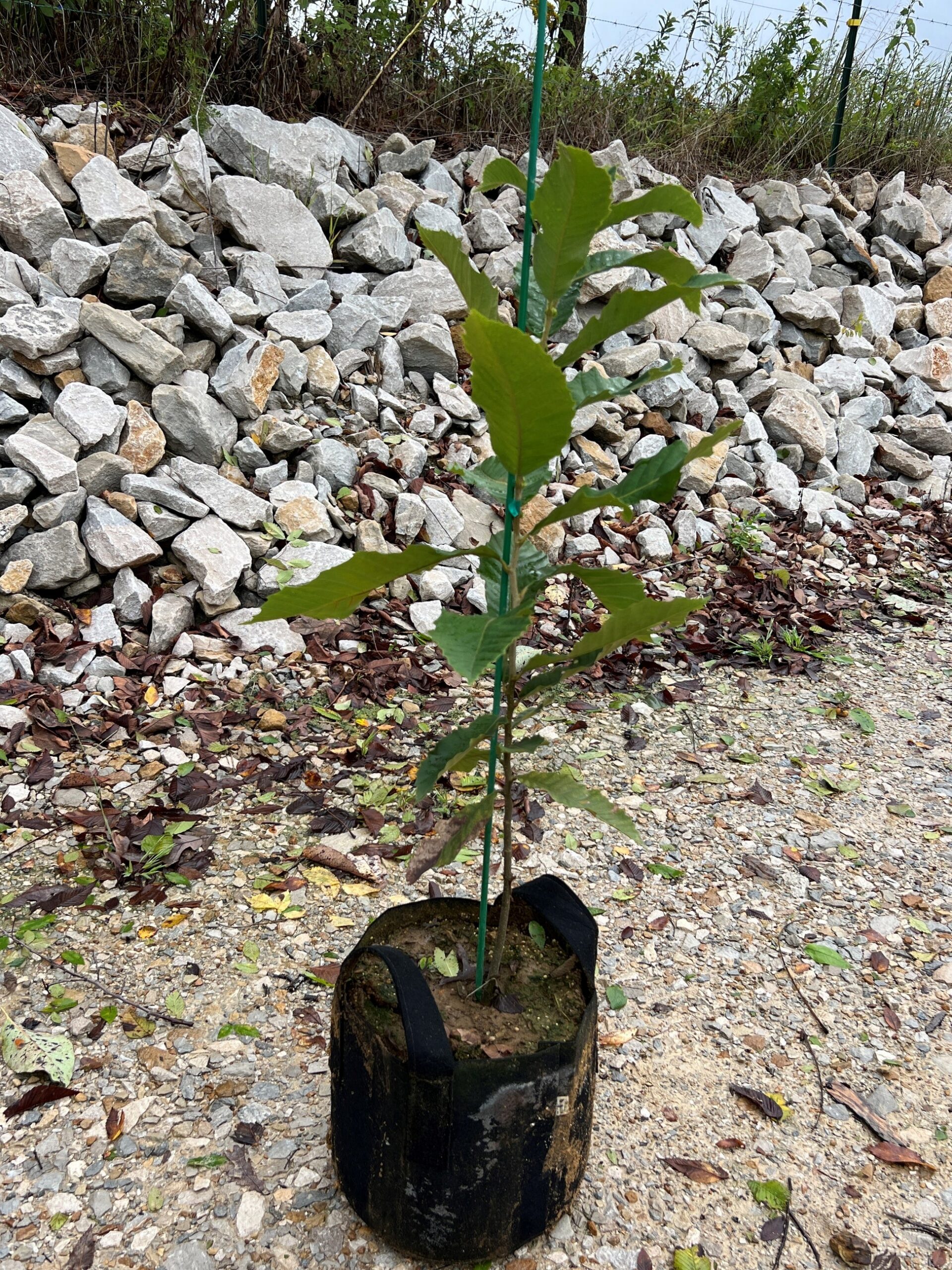
In chestnut nurseries, tall trees get all the attention. Six‑ and eight‑foot first‑year trees look impressive in the nursery rows. But height alone doesn’t tell you how that tree will perform once it hits real soil. At EBB Farms, the farm lab for United Chestnuts, we’ve taken a different path: we intentionally standardize our shipped chestnut seedlings at around four feet tall.
This choice isn’t about what looks most dramatic in a nursery block. It’s about what actually works best for growers, orchards, and long‑term tree health.
Why We Don’t Use Height as the Main Measure
It’s easy to assume that a taller nursery tree is automatically a better tree. In our nursery rows, our six‑ to eight‑foot chestnut seedlings can look like the clear winners. And yes, they are great trees. But long‑term success in chestnuts is driven far more by genetics and roots than by how many inches of top growth a tree puts on in its first year.
Fertilizer, irrigation, spacing, and container depth can all be dialed up to push height quickly. That makes for great‑looking nursery trees. Yet it can also mask weak root systems, poor structure, or genetics that won’t hold up under stress. We’d rather send you a chestnut seedling that’s built to survive drought, wind, and real‑world management than one that only wins a tape‑measure contest.
Genetics, Not Just Height, Drive Success
We view every chestnut seedling as a decades‑long investment. The Chinese chestnut and hybrid families we grow at EBB Farms are selected and propagated for:
- Strong genetic vigor and adaptability across a range of soils and climates
- Resistance or tolerance to key diseases and environmental stresses
- Reliable, high‑quality nut production over many years
What Our Farm Lab Testing Shows
Those traits are coded in the tree’s DNA and revealed through consistent performance over time. They don’t show up only as a tall stem in year one. At EBB Farms, we call ourselves the farm lab for a reason. We’ve been testing different genetics, root systems, and growing methods side by side in real‑world conditions, the same way a new chestnut grower experiences them. Season after season, we’ve seen that a well‑bred, nursery‑ready seedling with a dense, fibrous root system tends to establish more quickly and handle stress more smoothly. It often catches up in visible height quickly.
When you strip away the marketing, the real questions are: What is the parentage behind this seedling line? How do these trees actually establish and yield in the field? That is where we focus our energy.
Why We Standardize Around Four Feet for Shipping
We absolutely grow tall chestnut seedlings. Many of our seedling lines from known parent trees, including Sleeping Giant, Eaton, Hiram, UMCA PQK, Dunstan, Miller and others, routinely reach six to eight feet in their first year in the nursery. These larger trees are available for on‑farm pickup for growers who want that size and can transport and plant them promptly.
What we’ve seen is simple: bigger is not always better when it comes to transplanting. Other nurseries and researchers are seeing the same pattern. Larger nursery trees tend to suffer more transplant shock, take longer to rebuild a root–shoot balance, and can lag while smaller, well‑rooted seedlings simply take off.
University and extension research backs this up. The Connecticut Urban Forest Council’s “Influence of Tree Size on Transplant Establishment and Growth” shows that smaller transplanted trees often establish more quickly. In many cases they eventually outgrow larger trees. The reason is simple: they spend less time rebuilding lost root systems after planting.
A chestnut seedling in the three‑ to four‑foot range offers a better balance of strength, safety, and performance:
- Shipping integrity: Shorter, well‑balanced seedlings are far less prone to breakage, bending, or desiccation in transit.
- Easier planting: This size is simpler to handle, position, and stake if needed, especially for small crews or first‑time planters.
- Root–top balance: Roots and shoots are in better proportion. That helps the tree recover from shipping and push strong new growth in its first season on your site.
We’re not standardizing at this size because we can’t grow bigger chestnut trees. We’re standardizing there because it consistently protects the tree, the root system, and your long‑term investment—especially when those trees need to be shipped.
How We Grow Thousands of Seedlings: Root‑First in 3‑Gallon In‑Ground Grow Bags
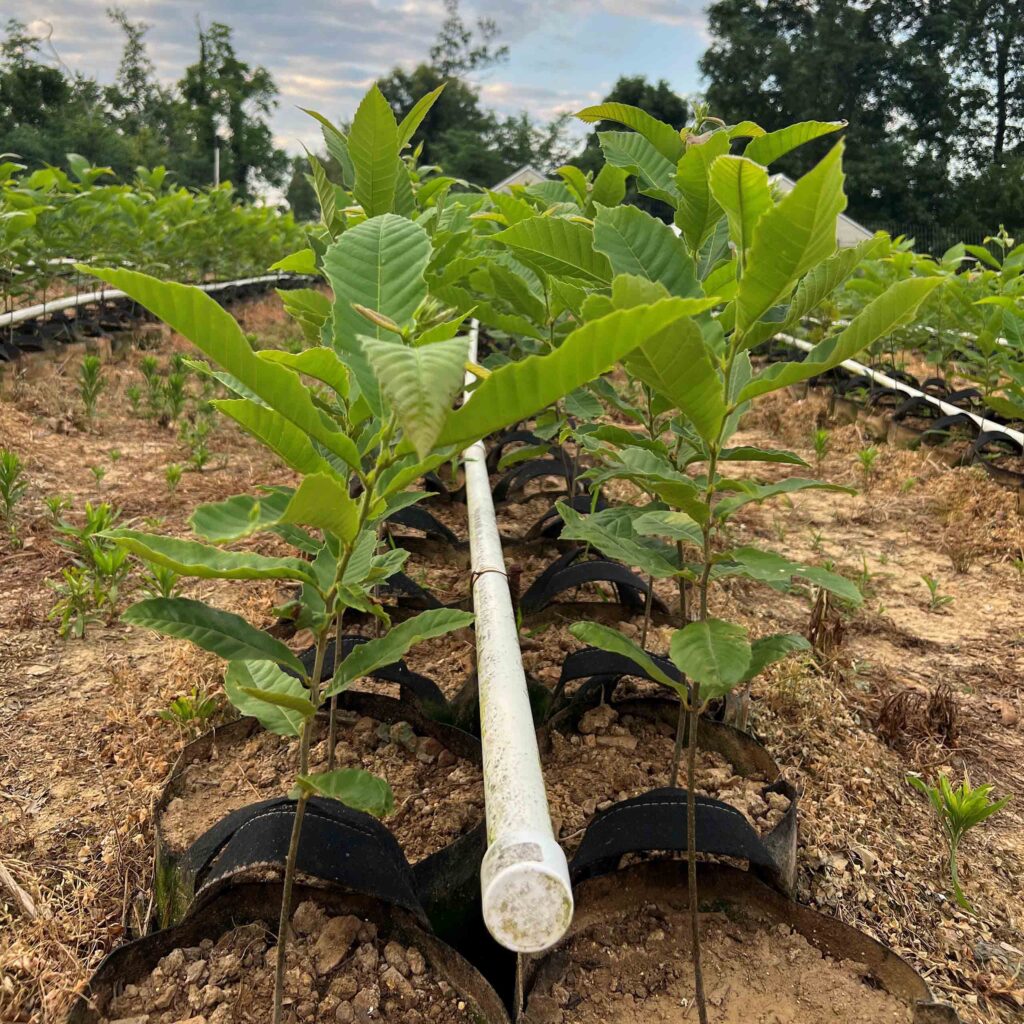
Each year at EBB Farms, we raise thousands of chestnut seedlings from known parent trees, and every part of that system is built around one principle: root‑first growing. Instead of traditional plastic containers that encourage circling and girdling, we use three‑gallon fabric grow bags set directly into the soil.
As roots grow outward and reach the breathable fabric, they encounter a high‑oxygen, drier interface at the fabric wall. In our system, that edge condition slows or stops the root tip and triggers branching behind the tip, reducing circling and building a more compact, fibrous root system with many fine roots. You avoid the few thick, coiled roots that cause problems later. Those fine roots dramatically increase the surface area for water and nutrient uptake and help reduce transplant shock after planting.
Because our grow bags are in‑ground—not sitting on hot gravel—the surrounding soil buffers temperature and moisture. It keeps the root zone cooler and more stable in summer heat. That stability supports steady root growth instead of stress spikes. When we lift the seedlings, we see a broad, evenly distributed root mass that anchors well and responds quickly once planted in its permanent home.
For growers, the result is simple but powerful: a chestnut seedling with a high‑quality, fabric‑grown, air‑edge‑pruned root system that wakes up quickly, anchors solidly, and makes efficient use of water and fertilizer from day one. Our shipping standard isn’t an accident—it’s the point where genetics, root architecture, and real‑world transplant performance all come together.
The Problem with “Bigger Is Better” Thinking
One of the most common questions we get is simple: “Can I get the taller trees I see in your nursery rows?” It’s a fair question. When you see six‑ to eight‑foot chestnut seedlings, it’s natural to assume they must be the best option. But when we walk growers through what actually happens after planting, the picture changes.
In the field, very tall young trees often carry more canopy than their roots can comfortably support right after transplanting. They can dry out faster and struggle more with water stress. Many spend their first season rebuilding roots instead of growing. Smaller, well‑rooted stock, by contrast, usually establishes quickly. Then it starts putting on steady, reliable growth.
Nursery peers are seeing the same thing. Edge of the Woods Native Plant Nursery notes in “Nine Reasons to Start Small” that larger trees often take longer to establish. Smaller trees establish their roots quickly and can catch up in size in a short time.
That’s why our message to customers is simple: if you’re picking up from the farm and planting immediately, those tall trees can be a great fit. If you’re having trees shipped, a compact chestnut seedling with a superior root system is usually the smarter, safer long‑term choice.
“My Buddy Has $3 Seedlings” — Why Ours Cost More
We’ve heard this line a lot. “My buddy has chestnut seedlings for three bucks. Why do your seedlings cost so much?” It’s a fair question, and the answer goes straight back to genetics, production method, and what you’re actually buying for the next 30–50 years.
Cheap seedlings are usually open‑pollinated from unknown parents. There is no tracking of which families consistently produce good nuts, strong structure, or reliable yields. In contrast, we build our seedling lines from proven Chinese chestnut and hybrid families that have shown strong performance in research and grower trials, and we raise them in root‑focused systems that prioritize establishment and long‑term productivity.
Why Breeding Programs Like UMCA® PQK Matter
Take UMCA® PQK as one example. UMCA® PQK seedlings come from a pollen‑isolated orchard of grafted trees—Peach, Qing, and Kohr—that serve as the known parents for this seedling population. The University of Missouri Center for Agroforestry has evaluated these parents for decades for yield, nut quality, disease resistance, and late‑frost resilience. Those parent trees reliably produce large, low‑defect nuts and drop cleanly from the bur. They leaf out late enough to dodge many spring frosts and show lower incidence of key diseases. When you plant a PQK seedling from that population, you’re not rolling the dice on whatever was growing in a fence row; you’re plugging into a curated breeding program designed to create high‑performing chestnut orchards.
Work from universities and grower networks has shown that orchards built on carefully chosen parent trees and well‑documented seedling families can deliver more consistent nut size, flavor, and yield. Those orchards often pay back their higher upfront cost through earlier and more reliable production. When you buy one of our nursery‑ready chestnut seedlings, you’re not just buying a tree in a box; you’re buying decades of selection, testing, and root‑system engineering aimed at making sure that tree actually earns its keep in your field. More information here.
What Growers Should Look For Instead of Just Height
Whether you buy chestnut seedlings from us or from another nursery, there are far better indicators of quality than a tape measure. Look for:
- Proven genetics with clear information on parent trees and performance data
- Strong, fibrous roots with minimal circling or girdling
- A sturdy, well‑lignified stem rather than a lanky, weak shoot
- Uniform, healthy growth across the batch
A well‑rooted, nursery‑standard chestnut seedling that checks all of these boxes will almost always beat a taller tree. Poorly rooted or over‑pushed stock simply does not perform as well over the long term.
Why Our Shipping Standard Matters
By committing to ship chestnut seedlings at this size range, we’re making a deliberate quality choice:
- We concentrate on the genetics and root systems that truly determine your long‑term success.
- We ship seedlings that travel well, arrive in good condition, and establish quickly in your soil.
- We deliver a consistent, predictable product year after year, so scaling an orchard or agroforestry system is easier.
At EBB Farms and United Chestnuts, our nursery is a working farm lab. We’re constantly observing, testing, and refining—from seedling trays to mature orchard blocks. Our shipping standard is a direct result of what we’ve learned in the field: long‑term success comes from genetics and roots, not just nursery height.
If you’re planning your next planting, don’t just ask, “How tall are the trees?” Ask, “How strong are the roots, and how proven are the parent trees behind these seedlings?” That’s the question this industry needs to start centering.