March 17, 2026
How Drone Technology Is Transforming Chestnut Orchard Management

If you’ve ever stood at the bottom of a steep chestnut grove with a heavy sprayer on your back, you’ve probably looked up at the canopy and wondered if there was a better way. For years, drone technology in chestnut orchards felt like something reserved for hobbyists or big-budget films, but as I learned from my conversation with Caleb Canter of AeroAg, these machines are quickly becoming the newest workhorses in sustainable agriculture.
Caleb isn’t just a tech enthusiast; he’s someone who grew up with a remote control in his hand and turned that passion into a fleet that treated over 21,000 acres last year. Whether you’re managing a few dozen trees or a commercial chestnut operation, Caleb’s insights show that this “eye in the sky” is doing a lot more than just taking pictures—it is changing how we care for our land.
From Hobby Toys to Industrial Tools
Caleb’s journey started with Styrofoam planes and “nerve-wracking” manual flights. But the real shift happened when the battery technology used in electric cars finally met the agricultural world.
“We went from lead-acid and nickel-cadmium to lithium-ion,” Caleb explained. That change allowed agricultural drones to carry heavy payloads—like tanks of organic fungicide or bags of cover crop seed—while flying autonomously. Today’s agricultural drones for chestnut orchards are not “steered” in the traditional sense; they are programmed to follow the contours of your land with incredible precision.
What Are the Benefits of Using Drones in Chestnut Orchards?
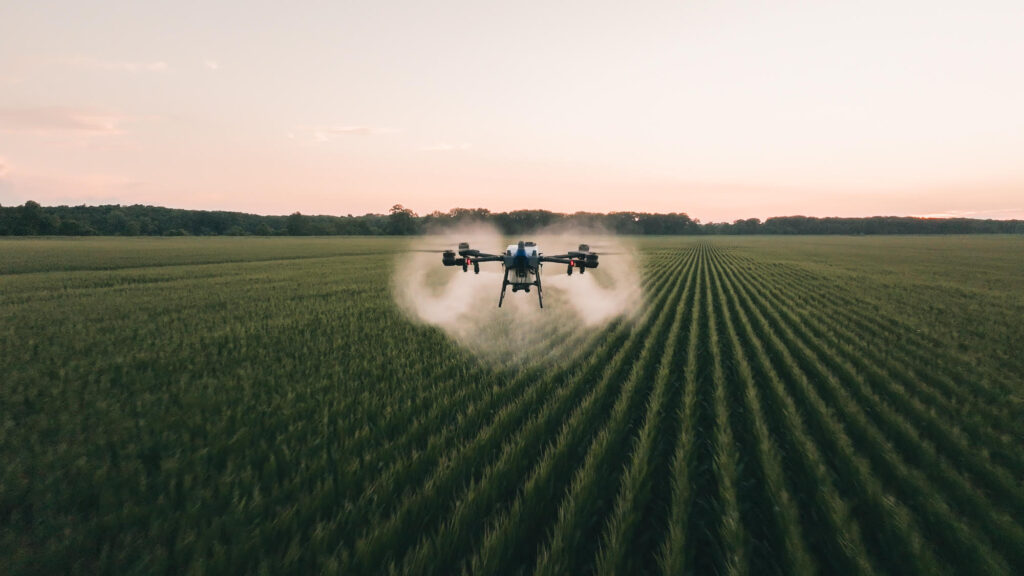
- The “Fog” Effect: Better Coverage for Tall Trees
One of the biggest hurdles in a chestnut orchard is reaching the interior of a dense canopy. Traditional tractor sprayers often blow right past the leaves or miss the undersides entirely. “When a drone is flying, it’s creating a massive amount of downward air,” Caleb said. That air creates a fine “fog” that swirls through the branches, coating the leaves from top to bottom. It means more effective protection for your trees with significantly less waste hitting the ground. - Safety on the Slopes
Chestnuts often thrive on “marginal” land—the kind of beautiful, rolling hills that are a nightmare for tractors. Every year, farmers face the risk of equipment tipping on steep grades. Drones solve this by moving the work to the air. Using LIDAR (laser sensors), these machines “feel” the ground beneath them. If the hill goes up, the drone goes up, maintaining a perfect distance from the treetops without ever putting a tire on a dangerous slope. - Beyond Spraying: A Multi-Purpose Partner
If you think drones are only for liquid applications, think again. Caleb described how quickly these units can be converted for different jobs. “You can take the liquid tank off and put a dry spreader on in about 30 seconds,” he noted. This allows growers to fly on cover crop seeds or granular fertilizers with GPS accuracy. Caleb even hinted at a future where drones help with harvest logistics—lifting heavy baskets of nuts out of hard-to-reach hollows to a central collection point. - Seeing the Invisible with Orchard Mapping
We have all had that moment where we realize a tree is stressed, but only after the leaves have already turned. By the time we see it, the problem is well-established. By using specialized sensors, drones can create 3D maps of your orchard that highlight “plant stress” before it is visible to the human eye. This allows you to spot a nutrient deficiency or a pest outbreak in one specific corner of the farm and treat it before it spreads to the rest of the block. - The “Buy vs. Hire” Dilemma
Investing in technology can be intimidating. A full industrial drone setup can range from 27,000 to 45,000 dollars—a big jump for a small grower. Caleb’s advice: you do not have to own the machine to get the benefit. For many chestnut growers, hiring a drone service provider is the way to go. You get the precision and the safety without having to manage the maintenance, the battery charging stations, or the 12-to-14-week FAA licensing process.
A Growing Community
Technology can feel like a departure from the “earthy” side of farming, but as Caleb showed us, it is really just a new tool to help us do what we have always done—watch over our trees with care and intention. Whether it is protecting our soil from the compaction of heavy machinery or finding ways to keep ourselves safer on the hills, the goal is the same: healthy trees and a sustainable future for modern chestnut orchards.
Ready to see your orchard from a new perspective and explore drone technology in chestnut orchards? Listen to the full conversation with Caleb Canter on Apple Podcasts, Audible, iHeart Radio or Spotify, and visit United Chestnuts to keep up with the latest in chestnut innovation.
Key Takeaways
- Drone technology in chestnut orchards is transforming sustainable agriculture by enhancing spraying efficiency and coverage.
- Drones create a ‘fog’ effect that allows better access to dense canopies, reducing waste and improving tree protection.
- These machines excel on steep terrains, utilizing LIDAR for precision without risking equipment tipping.
- Drones offer multi-purpose capabilities, from spraying to seed spreading, and may assist in future harvest logistics.
- For small growers, hiring drone services can be more economical than purchasing equipment outright, providing access to advanced technology.