You’ve walked your rows with a question no one nearby could answer: is that canker on the bark blight, and what do you do about it in soil like yours?
Questions like that are what a Specialty Crop Block Grant can pay to answer, and chestnut growers can apply.
What Our Kentucky Specialty Crop Block Grant Will Fund
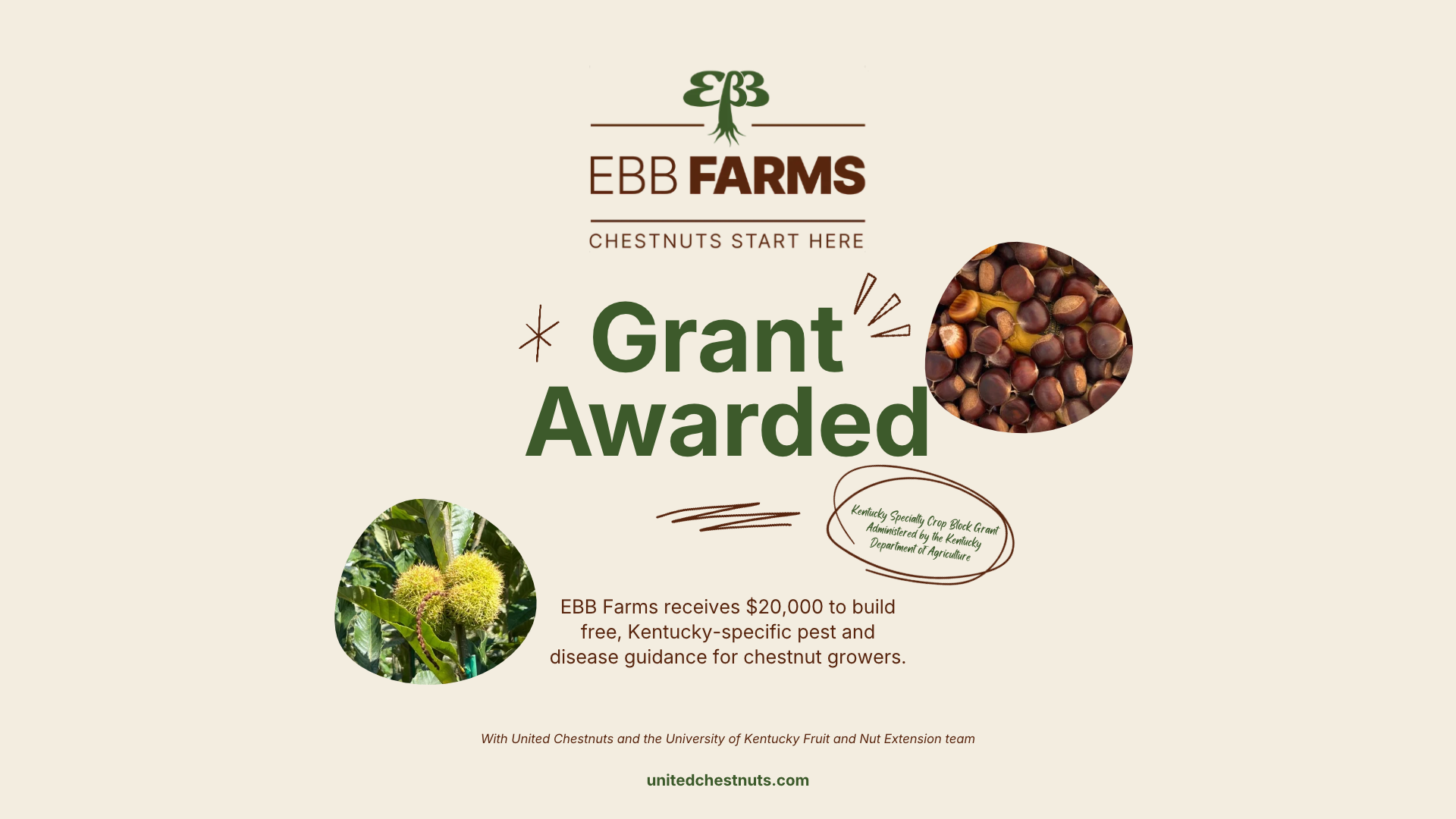
United Chestnuts and EBB Farms have been awarded a Kentucky Specialty Crop Block Grant, funded by the USDA Agricultural Marketing Service and administered by the Kentucky Department of Agriculture. With the University of Kentucky Fruit and Nut Extension team, we’ll develop educational materials on three problems chestnut growers deal with in every region: chestnut weevil, chestnut blight, and Phytophthora (ink disease).
Most of the guidance on these comes from other states. Kentucky’s heavy clay and humid summers change the answers, so the work starts in a working orchard here. EBB Farms planted its first chestnut trees in 2018, for hunting, and started its orchard in 2022. Both times, there was no local reference to turn to. Everything this project produces will be shared free through UC Academy, so growers in Kentucky and beyond have one.
Are Chestnuts a Specialty Crop?
The USDA defines specialty crops as fruits, vegetables, tree nuts, dried fruits, and horticulture and nursery crops. Chestnuts are tree nuts. If you grow them, sell seedlings, or work with chestnut growers, your project falls inside the crops this program was built for.
How Does the USDA Specialty Crop Block Grant Program Work?
The USDA sends block grant funds to each state’s department of agriculture. Each state runs its own competitive application, sets its own priorities, and picks its own deadlines.
One rule shapes every application: the project has to benefit the specialty crop industry, not one farm or business. That’s why our project produces free guides, field reports, a public farm tour, and a podcast episode, and not upgrades only EBB Farms would use.
How to Apply for a Specialty Crop Block Grant in Your State
- Call or email your state department of agriculture: Ask whether it runs a Specialty Crop Block Grant program and when applications open. Timing varies by state. If you haven’t met your local agriculture offices yet, start there. Our guide on how to get a farm number walks through how we built that relationship with our USDA Service Center, and the same habit of asking early helps here.
- Read your state’s priorities: Many states publish what they want funded each year.
- Find a partner: We worked with the University of Kentucky Fruit and Nut Extension team. A local extension office, university, or grower group can strengthen both the proposal and the work.
- Plan something other growers can use: Ask who besides you benefits. If the answer is growers across your state, you’re on the right track.
- Start with what you already know: Our proposal grew out of a smaller project: a UC Academy guide on protecting young chestnut trees from ambrosia beetles, published in March 2026. Writing it showed us how much local research was missing.
When Kentucky Chestnut Growers Can Expect Free Pest and Disease Guides
The project begins this fall. As the protocols, photo reference, and field reports are ready, we’ll share them through UC Academy and here on the blog.
If you’re putting together a proposal in your state, email us at [email protected] and tell us which question your project would answer. Research in more regions means better answers for every chestnut grower.