September 13, 2026
Why Water Is One of the Most Important Resources on a Chestnut Farm
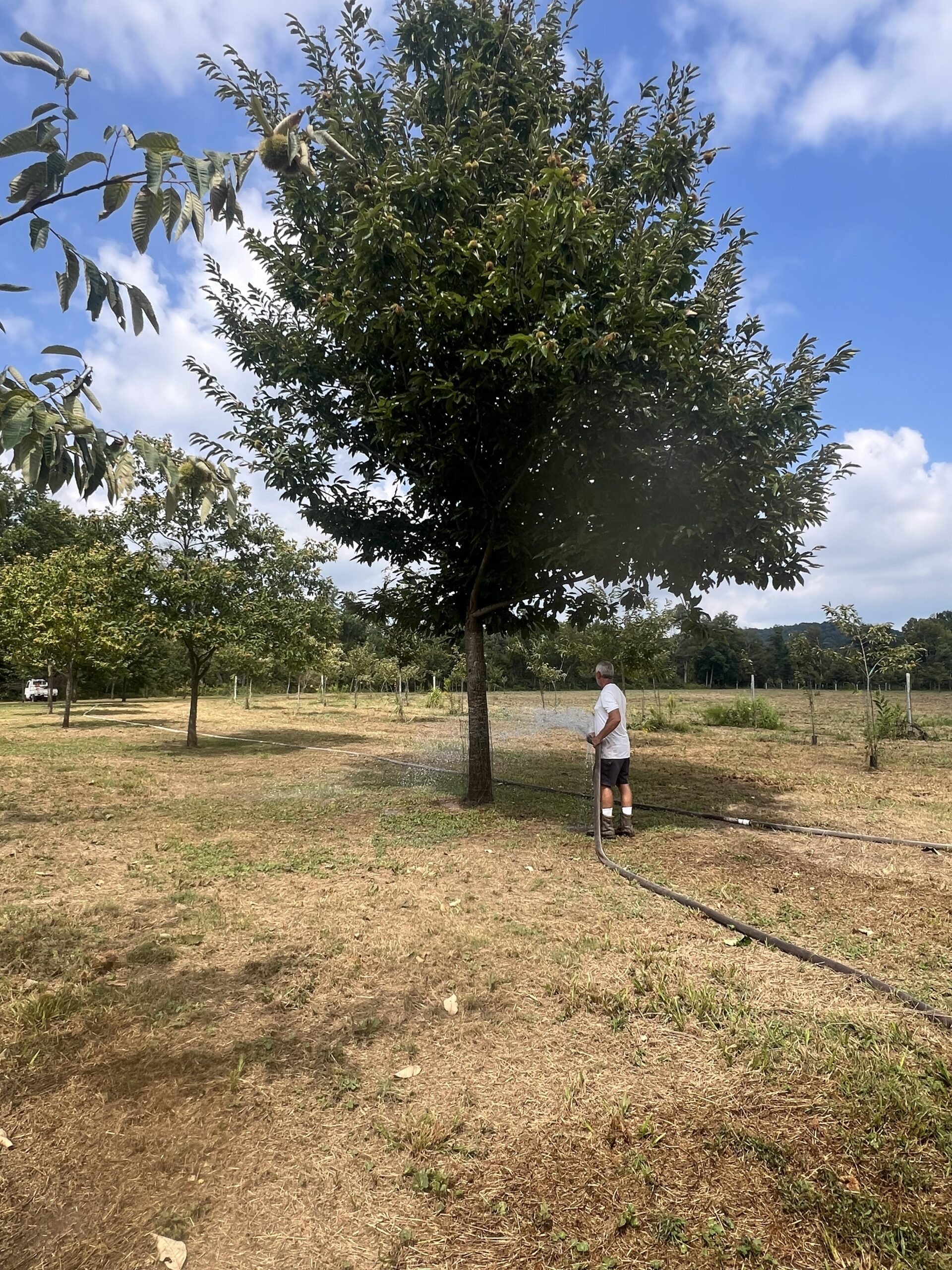
A few weeks ago, we walked out into the orchard after a long spell of extremely hot weather and no rain. Kentucky had given us a good, rainy summer. Then, almost overnight, the rain just stopped. The burrs were still sizing on the trees, and our permanent irrigation system is going in next year. So fire hoses donated by a fire station became the plan for right now. We are able to pump water from a river boarding several of our orchards.
That afternoon summed up something we think about constantly as we build this farm. Water is not one task on a long list. It is the resource that decides whether everything else we do here even works.
Water decides the harvest before you ever see it
Here is a number that changed how we think about late summer. A ripe chestnut is roughly 40% water and 40% carbohydrate by weight. Most of that weight gets packed on in the final two to three weeks before the nuts ripen (University of Florida IFAS). That window lands right around now for us, with harvest running mid-September through October.
In other words, the crop is not made at harvest. It is made in the weeks just before it. A dry stretch during nut fill will not always hurt a tree. But it can shrink the nuts, and it can shrink the yield (UC Davis Fruit & Nut Research). That is the trade-off we are watching every single afternoon this time of year.
So we walk the orchard in late afternoon, when heat stress shows up first. We look for leaves folding or drooping, green burrs dropping early, or any scorch on the leaf edges. Then we check the soil six to twelve inches down near the heaviest-cropped trees. If it is still moist, the tree can wait. If it is not, that tree gets water that day, not next week.
Young trees and nursery seedlings are the most fragile of all
If mature trees are patient, young ones are not. A newly planted seedling has a small, shallow root system and almost no reserve to draw on. That is why the first two to three growing seasons are the most critical stretch for consistent water
We saw this play out in our own nursery block this summer, and it taught us something we will carry forward. Seedlings with grass and weeds still growing around them stayed noticeably greener through the dry stretch. That ground cover was holding moisture right at the surface. Once an area was cleared, those same seedlings responded to the heat much faster. Side by side, it was a clear, live demonstration of how much surface cover buffers moisture for a young root system.
That kind of real-world comparison is worth more than anything we could read in a manual. It is exactly why we watch new plantings so closely. It is also exactly the kind of hands-on detail we want other growers to have going in.
What we check on young trees and nursery stock
- Soil moisture six to ten inches down, not just the surface
- Leaf color and any curling, especially by mid-afternoon
- How much shade or moisture-holding ground cover surrounds new plantings
- Mulch depth, kept generous around the root zone but off the trunk itself
More water is not always the answer
Here is the part that surprises new growers. Chestnuts are just as sensitive to too much water as too little. Their roots need oxygen. Saturated soil pushes that oxygen out, and it can smother roots and invite crown and root rot (Michigan State University Chestnuts). Chestnut ground should be kept as dry as reasonably possible right around the trunk. Meanwhile, the surrounding root zone should stay evenly moist (UC Davis Fruit & Nut Research).
So the goal is not “more water.” The goal is the right amount, in the right place, at the right depth. Getting that balance right, consistently, across an entire orchard is exactly why a real system beats a hose in the long run.
What we are building at EBB Farms
This has been an unusually full year for our family. We said goodbye to both of our parents. We also worked through a hip replacement along the way. Life sets the pace on a farm just as much as the weather does. This year, that meant our irrigation build moved to next year’s calendar.
That extra runway has not been wasted time. We have spent it designing the system properly. For some of the orchards, it is a row-based drip layout that pulls water straight from the river bordering our property. In other areas we will use gravity fed water from holding tanks. From there, it runs through mainlines, laterals, filters, and valves, straight into the tree rows. Water goes to the tree, not to the hay alley beside it. That keeps the system efficient and lets the alleys do their own job of hay and access.
We would rather install this once and install it right, instead of rushing it in the middle of everything else this year has asked of us. In early 2027, we will document the entire build in a UC Academy guide, start to finish. That way, new chestnut farmers can see exactly how a working farm plans and installs orchard irrigation from the ground up.
The takeaway
Water is the quiet variable behind almost everything on a chestnut farm. It decides nut size before harvest. It decides how a seedling handles its first summer. Too little and the crop shrinks. Too much and the roots suffer. Getting it right, tree by tree and season by season, is a big part of what “growing chestnuts well” actually means.
That is the whole idea behind EBB Farms as our farm lab. Every lesson we share through United Chestnuts, including this one, gets tested on our own trees first. Real experience, not theory.
If you are thinking about planting your own chestnuts, orchard-scale or backyard, don’t forget to explore your watering plans. Often it’s an exercise in creativity and innovation but that’s why we do this, isn’t it?
Thinking about starting your own chestnut farm or hunting paradise? Come walk our orchard and nursery with us. We host one-on-one farm tours for growers exploring exactly these questions. And we sell chestnut tree seedlings for chestnut farming and hunting properties from the nursery.
👉 Shop trees, chestnuts, farm tours and more.
Sources
- University of Florida IFAS Extension, Production and Marketing of Chestnuts in the Southeastern United States (HS1155) — https://ask.ifas.ufl.edu/publication/HS1155
- UC Davis Fruit & Nut Research and Information Center, Chestnut Culture in California — https://fruitsandnuts.ucdavis.edu/sites/g/files/dgvnsk12441/files/391-244.pdf
- Michigan State University Chestnuts, Irrigation — https://www.canr.msu.edu/chestnuts/horticultural_care/irrigation