April 9, 2026
How to Prevent Ambrosia Beetle Damage on Young Chestnut Trees
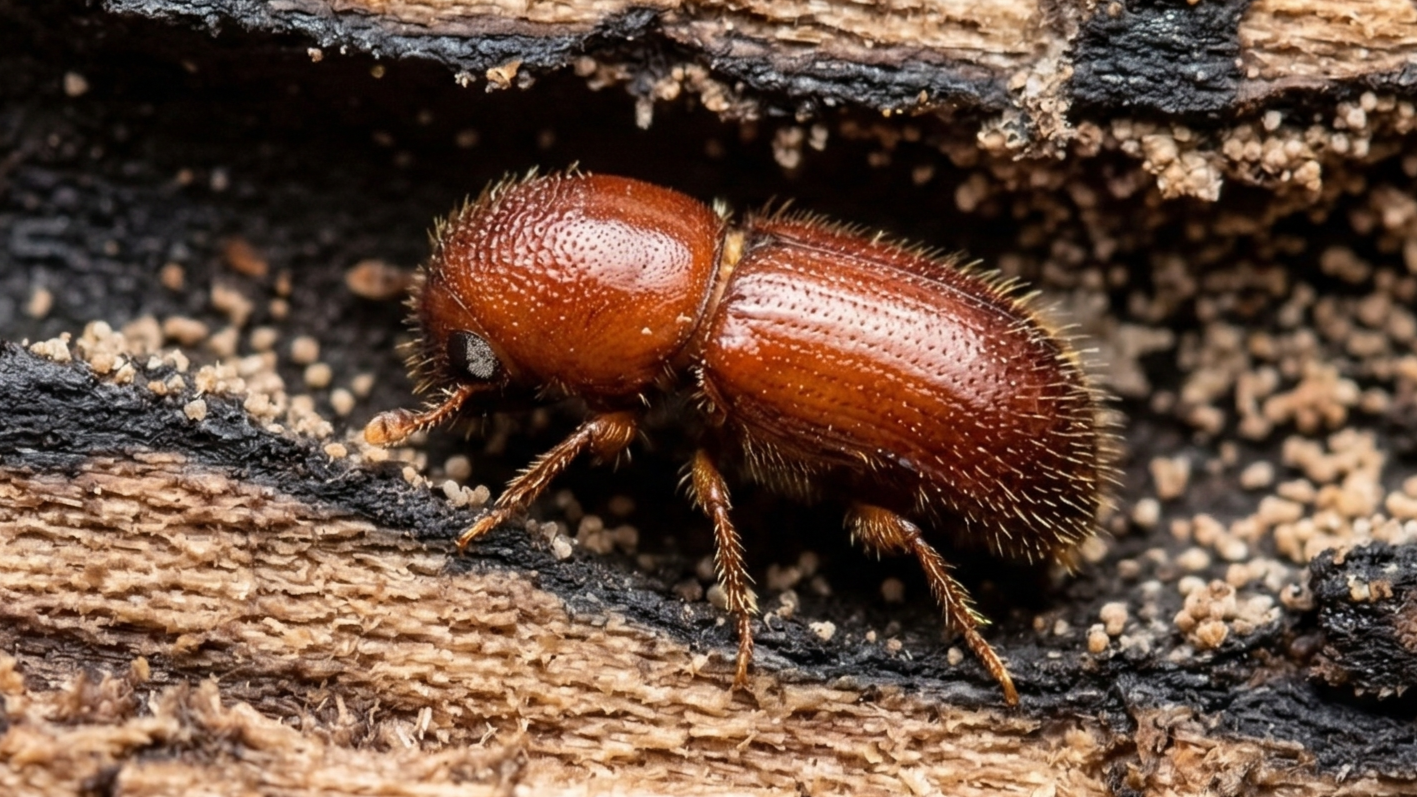
If you’re establishing chestnut trees in the Southeast or lower Midwest, there’s a challenge you’ll likely face in the first three to four years after planting: ambrosia beetle damage.
These rice-sized wood-boring insects are one of the most common threats during the establishment window—targeting trees between ½ and 4 inches in diameter, exactly when your investment is most vulnerable.
Why Ambrosia Beetles Target Young Chestnuts
Unlike typical bark beetles that feed on tree tissue, ambrosia beetles don’t eat wood. Instead, they bore into young trunks to cultivate a symbiotic fungus. This fungus blocks the tree’s vascular system, cutting off water and nutrients during critical spring growth.
The real issue? Once galleries girdle the stem, the tree collapses. By the time you see wilting foliage, rescue is often economically impossible.
Here’s what makes young chestnuts particularly susceptible: ambrosia beetles navigate using chemical signals. They’re attracted to ethanol, which stressed trees produce from transplant shock, drought, flooding, or poor drainage.
Recent research found that trees with waterlogged roots produce ethanol concentrations 7 times higher than healthy trees. If you’re planting in heavy clay or low-lying areas without proper drainage assessment, your trees become chemical beacons to overwintering beetles.
The Temperature Trigger You Need to Know
Ambrosia beetle flight doesn’t follow a calendar—it follows temperature. Beetles emerge after three consecutive days at 70°F or higher during the pre-bud-break window.
Regional flight timing varies:
- Deep South (GA, AL, SC): Early to mid-March
- Mid-South (TN, KY, NC): Mid to late March
- Mid-Atlantic (VA, MD): Late March to early April
Attack pressure lasts until trees reach full leaf-out, when the canopy closes and beetles lose interest.
Understanding the Biology Changes Your Strategy
Preventing ambrosia beetle damage starts before beetles fly. Site selection, drainage, stress reduction, and monitoring systems form the foundation—but timing and execution during the flight window determine whether you protect your trees or lose them.
The difference between growers who eliminate early-stage mortality and those who struggle year after year comes down to understanding the biology: why beetles target specific trees, what triggers flight, and how to deploy preventative barriers before the attack begins.
Get the Complete Management Playbook
We’ve compiled everything we’ve learned about ambrosia beetle biology, prevention, and integrated management into one comprehensive resource: Protecting Young Chestnut Trees from Ambrosia Beetle Attack.
Preview the guide below, then download the complete 21-page playbook for:
- The 70°F temperature trigger and regional flight maps
- Cultural practices that reduce tree stress and ethanol signals
- The TACF preventative spray protocol with timing and application methods
- Monitoring systems using ethanol-baited traps
- Rapid sanitation strategies for infected trees
- Emerging semiochemical technologies and biological controls