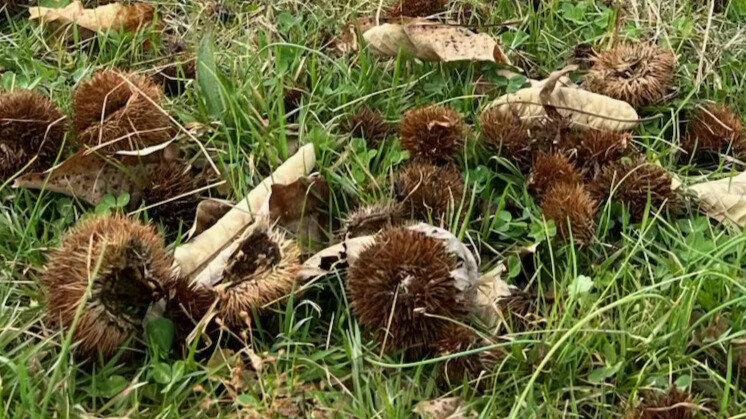
If you grow trees, you know exactly what chestnut orchard waste looks like by the end of October. The sorting tables have run for weeks, the coolers are packed to the ceiling, and the trees are finally bare. But out back, or at the end of the processing line, the pile is growing. The cracked shells. The empty, spiny burs. The undersized nuts that didn’t make the grade.
You look at that pile and see the fertilizer you paid for, the water you pumped, and the hours of labor you gave to the land. And then, because the traditional commodity system demands it, you sweep it up and pay to have it composted, burned, or hauled away. But what if we’ve been looking at it all wrong?
The Real Cost of the Commodity Trap
Before we talk about making money from waste, we have to talk about how we are currently losing it.
In a recent episode with Roger Smith of Prairie Grove Chestnut Growers, he shared a story that perfectly captures the vulnerability of the legacy grower. He recalled a season where a massive harvest maxed out his cooler space, leaving him with 30,000 pounds of surplus chestnuts sitting in his office. Because his traditional infrastructure couldn’t handle the overflow and he didn’t have secondary markets built out, he was forced to drop his prices from $4 to $3 a pound and wholesale the crop just to clear the floor.
He took a massive financial hit. When we operate only as passive growers and don’t have a plan for our surplus or our chestnut orchard waste, the middlemen win. We become price-takers. Escaping that trap requires us to become data-driven merchants who dictate the value of our entire crop.
Rethink Chestnut Orchard Waste as Bio-Feedstock
The global market is quietly rewriting the rules of agriculture. Today, dozens of massive industries are searching for raw agricultural byproduct to replace petroleum plastics and synthetic chemicals.
What a legacy grower calls debris, modern manufacturing calls “bio-feedstock.” This is any renewable biological material that can be converted into industrial chemicals, energy, or bioplastics.
Independent farms that realize this are building the infrastructure to supply these secondary markets. It is the key to finally breaking free from the commodity trap and keeping the true wealth of the harvest on our own land.
The Beauty Industry is Buying Upcycled Ingredients
Skincare company KraveBeauty recently demonstrated exactly how this works with the launch of their Lip Barrier Relief. They took discarded almond shells—material that usually rots on the orchard floor—and extracted the nutrients to build a premium, high-margin cosmetic product.
Clinical research shows that chestnut shells and spiny burs are dense with polyphenols, tannins, and antioxidants. These are the precise compounds cosmetic chemists purchase to formulate anti-inflammatory toners, skin-protecting serums, and high-end skincare treatments. The market already exists for what we are sweeping off the floor.
Pressing Chestnut Orchard Waste into Bioplastics
The opportunity doesn’t stop at skincare. The rigid structure of the chestnut makes it incredibly valuable to the industrial sector.
Bioplastic engineers are currently processing raw, discarded nutshells using hot compression molding to create highly durable, eco-friendly composites. Manufacturers want these consistent, hard materials to press heavy-duty agricultural pallets and rigid harvest bins.
Meanwhile, food technology companies are milling the fibrous outer layers of nuts to extract dietary fiber. Food scientists are actively incorporating Portuguese chestnut shells into chestnut flour to increase the protein content and improve the amino acid profile of the final product. Commercial bakers use these enriched flours to lower the glycemic index of their bread.
The Operational Requirements for Selling Upcycled Farm Byproduct
Seeing the vision is easy. Doing the work is where the friction lives and if you’ve made it this far into the article, we’re sure the thought has crossed your mind, “This is inspiring but, it’s also just giving me a list of more things to buy and more work to do.“
It’s true. You cannot just sweep up the sorting room floor and ship a tote to a commercial lab. Selling into this new economy means treating our chestnut orchard waste with operational reverence. It requires:
- Climate-Controlled Storage: Raw shells rot and grow mold when left in a damp pile. You must dedicate clean, dry storage space and strict moisture-control protocols to material you used to leave in the dirt.
- Rigorous Lab Testing: Buyers require upfront lab documentation proving your byproduct is free from pesticides, heavy metals, and harvest soil. A single failed test ruins the entire batch.
- Flawless Traceability: You must implement digital inventory systems that trace every pound of byproduct back to the specific orchard block and exact harvest date to satisfy Good Agricultural Practices (GAP).
Because the alternative is continuing to bleed margin and accepting that our margin will always belong to someone else. Let’s be incredibly clear about this: building clean storage and running lab tests is not a magic wand. Cosmetic brands and bioplastic manufacturers aren’t going to just show up at your orchard gate tomorrow with a high-margin contract. Finding these buyers, building the relationships, and figuring out the logistics takes time, networking, and serious legwork.
But having this infrastructure in place is the absolute minimum cost of entry. You cannot pitch a cosmetic chemist or an industrial engineer with a bucket of floor sweepings. They won’t even answer the email if you don’t have GAP traceability and clean lab reports.
That upfront investment buys you readiness. When you hold clean, stabilized, lab-tested bio-feedstock, you fundamentally change your position. You stop being a passive grower scrambling to offload surplus to a grocery broker before it rots, and you become a merchant holding stable, valuable inventory. You give yourself the runway to step into these secondary markets, build those relationships, and eventually keep the true wealth of the harvest on your own farm.
Navigating the Messy Middle Together
This transition is not easy. Moving from the old way of doing things into this new, modern chestnut ecosystem causes friction. As we’ve talked about before, as growers, we are currently navigating the “Messy Middle” of the American nut revival.
It is a transition phase where we have to stop operating like passive farmers and start thinking like data-driven merchants. At United Chestnuts, we don’t see the messy middle as a problem to solve quickly. We see it as a phase to move through thoughtfully. Messy in the Middle isn’t a slogan for us; it’s a lens we use to intentionally and honestly normalize this season instead of rushing past it.
Because if the pistachio industry taught us anything, it’s this: the middle is where the future is built. Figuring out how to upcycle our harvest debris and keep that wealth on the farm is exactly how we build our way forward.
The good news is that you don’t have to navigate this transition alone. If you’re ready to stop leaving money on the orchard floor, head over to resources to explore our library, or look into joining the Chestnut Growers of America to plug into the broader industry. Make sure to subscribe to the Branching Out: Growing Together podcast wherever you listen. Right now, the middle is exactly where we are—let’s build the future of this industry together.